

For middle part vs side part men should not start with a rigid face-shape rule. Start with the direction the hair already grows, whether the front is long enough to separate, and what each placement does to the forehead and outer silhouette. A middle part usually creates a balanced curtain and exposes the center of the face; a side part creates diagonal movement, lifts one side and can make the outline feel less symmetrical. Neither is universally better.
The most reliable decision is a controlled, reversible test. Style both options on separate days with the same haircut, product amount, camera and light. Review the front and three-quarter views at normal size, then choose the part that stays in place, fits your routine and gives the frame you want. MogRise can organize consistent front and profile observations, but it cannot replace your natural growth pattern or decide your identity from a score.
Middle part vs side part men: what actually changes
A part is a line of direction, not just a line of visible scalp. With a middle part, volume is divided on both sides and the eyes travel vertically through the center of the forehead, nose and chin. This can make balanced length and cheek framing more noticeable. With a side part, the heavier section crosses more of the top and creates an oblique line. That line may add height, soften a very even outline or direct attention toward one brow and cheek.
These are presentation effects rather than changes to facial structure. The result also depends on density, curl pattern, hairline, temples, glasses, facial hair and the amount of weight above the ears. A center part in loose waves behaves differently from a sharp center line in straight, flat hair. Likewise, a soft off-center sweep is not the same as a polished hard part. Compare specific versions you can maintain, not abstract labels from a face-shape chart.
Let the growth pattern make the first vote
Wash or thoroughly wet the hair, remove heavy product and let it settle for several minutes. Look at the front roots and crown. A cowlick may push the fringe to one side; a crown whorl may make a perfectly straight center line split or rise. Place a comb at the forehead and follow the route that opens with the least force. The natural line is not mandatory, but moving far against it usually requires more heat, product and attention.
Check the part after walking outside and after the hair is fully dry. If it repeatedly returns to one side, that is useful information rather than failure. Ask a barber to map the growth before shortening the top because length can either weigh a cowlick down or make it spring up. If you notice sudden thinning, scalp symptoms or unusual shedding, do not diagnose it from a part photo; a dermatologist or clinician is the appropriate source for medical assessment.
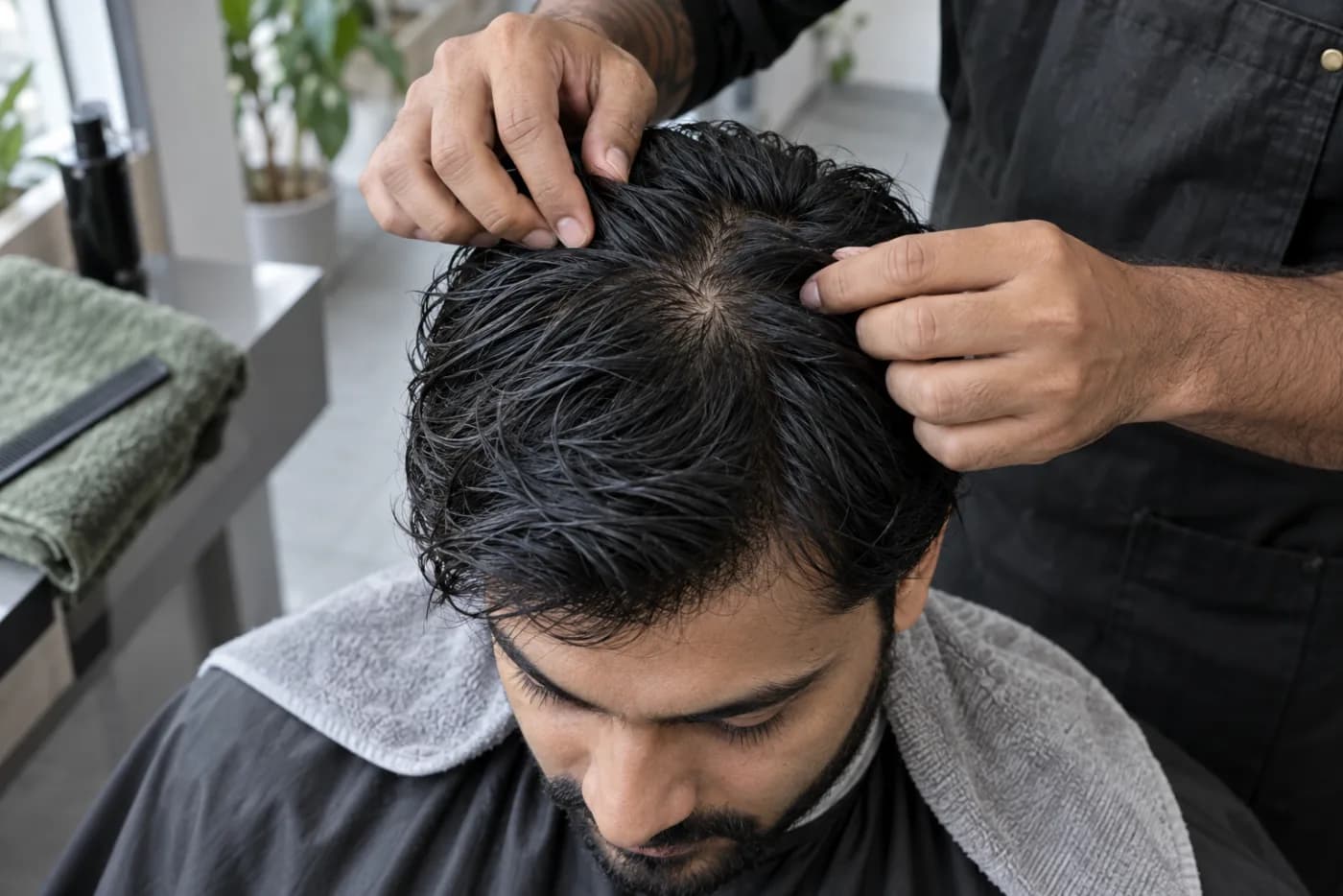
Check whether your current length can form both options
A middle part needs enough front length to travel away from the center without falling straight into the eyes. Thick or wavy hair may need internal weight removed, while fine straight hair may need some length retained so the sides do not collapse. A side part can work shorter, but a very short top may create only a directional brush rather than a visible line. Do not judge a desired style on a haircut built for the opposite direction.
Before cutting, use clips or a small amount of light cream on damp hair to simulate each route. Do not carve a hard line or load the hair with strong clay just to make the experiment survive. Our guide to clay, paste and cream explains why hold and finish should match the hair rather than rescue an incompatible shape. If your hairline is changing, the receding-hairline haircut guide offers options that work with density instead of disguising it through a forced part.
Run a temporary middle-part test
On towel-damp hair, draw a soft line from the center or a few millimeters off-center and comb each half outward. Use fingers at the roots to create air rather than pressing the top flat. Let the front fall where it naturally wants to bend. The goal is not a perfect social-media curtain; it is to learn whether both sides separate cleanly, whether the line exposes more scalp than you like, and whether the length frames the temples without covering your eyes.
Wear the result for a normal morning. Observe it after commuting, moving your head and putting on a jacket. A style that looks excellent for one still photograph but collapses after twenty minutes is not automatically the better choice. If one side behaves differently, try a slightly off-center placement before abandoning the family of styles. Small movement often respects a cowlick while preserving the balanced visual idea of a middle part.

Run the matching side-part test
Reset the hair with water on another day. Find the point where the head begins to curve away, often near the outer edge of the brow, and create a soft side line there. Move the larger section diagonally back or across, depending on length. Keep the smaller side relaxed rather than slicking it tightly to the scalp. A side part should give direction and manageable lift, not look like a painted stripe unless a deliberate classic finish is your goal.
Use the same amount of product as in the middle-part test. If the side version appears better only because it has much more volume or stronger hold, you are comparing styling intensity rather than placement. Note whether the diagonal opens one temple, changes how glasses sit in the composition or makes the top look disproportionately high. Keep the whole head and shoulders in view; extreme close-ups exaggerate the line and remove the context that makes a hairstyle work.
Style with less heat and less tension
Dry in the direction you want the roots to settle, using fingers or a vented brush and a low or medium temperature. The American Academy of Dermatology advises limiting heat because excessive heat can damage hair. Keep the dryer moving and stop once the shape is set rather than baking one line into the roots. A pea-sized amount of flexible product is usually a better test than a glossy, rigid finish that hides how the hair behaves.
Avoid repeatedly pulling a stubborn part tight. The AAD also warns that hairstyles creating continuing tension can contribute to traction-related hair loss; pain or stinging means the style is too tight. A loose part should not hurt. If your preferred direction demands aggressive heat, strong tension and constant correction, that maintenance cost belongs in the decision. The easier option often looks better because it keeps movement and does not appear overworked by midday.

Use face framing as a decision, not a verdict
Describe what you see without turning it into a universal rule. A middle part may show more forehead, create two vertical curtains and repeat a balanced center line. A side part may create lift, asymmetry and a stronger diagonal. Ask which effect supports your real goal: more openness, less visual width at the sides, easier control, or a softer forehead frame. Face shape is context, but texture and growth often matter more than a category such as oval or square.
This is where an explained MogRise review can be useful. Use consistent front and profile photos to identify the visible hair-to-face relationship, then select one reversible experiment. The what-to-optimize framework keeps high-control choices such as part placement, volume and product ahead of low-control anatomy. Treat any analysis or score as planning context, never as objective value or a command to hide a normal feature.
Compare both parts with a fair photo set
Take front and three-quarter photographs for each version at the same time of day. Keep the camera at eye level, use the same lens and distance, include the shoulders and relax your expression. Label the sets by style, not by a score. Review them after a few hours rather than switching rapidly in the mirror, because repeated close inspection makes tiny differences feel more important than they are. Also ask how the style looked after ordinary movement.
Judge four things: whether the roots cooperate, whether the front stays clear, whether the overall silhouette feels intentional, and whether the routine is realistic. MogRise can help keep observations and next steps together, but the final choice is yours. If the evidence is mixed, choose the easier version for two weeks and ask your barber to preserve enough length to switch. A hair part is a flexible grooming tool, not a permanent classification of your face.

Bring a precise request to the barber
Show one photograph of your successful test and explain what failed in the other version. Ask the barber to preserve the length required at the front, manage bulk around the temples and respect the crown direction. Say how many minutes you are willing to style and whether you use a dryer. Those constraints are more actionable than asking for a cut that suits a named face shape. A good consultation connects growth, density, finish and maintenance.
The practical answer is therefore conditional: choose a middle part when both sides separate comfortably and you like the balanced, open frame; choose a side part when the growth favors one direction or you prefer lift and diagonal movement. Try an off-center part when the natural line sits between them. Test before cutting, use gentle heat and review real-life wear. The best part is the one that looks deliberate without demanding a daily battle.