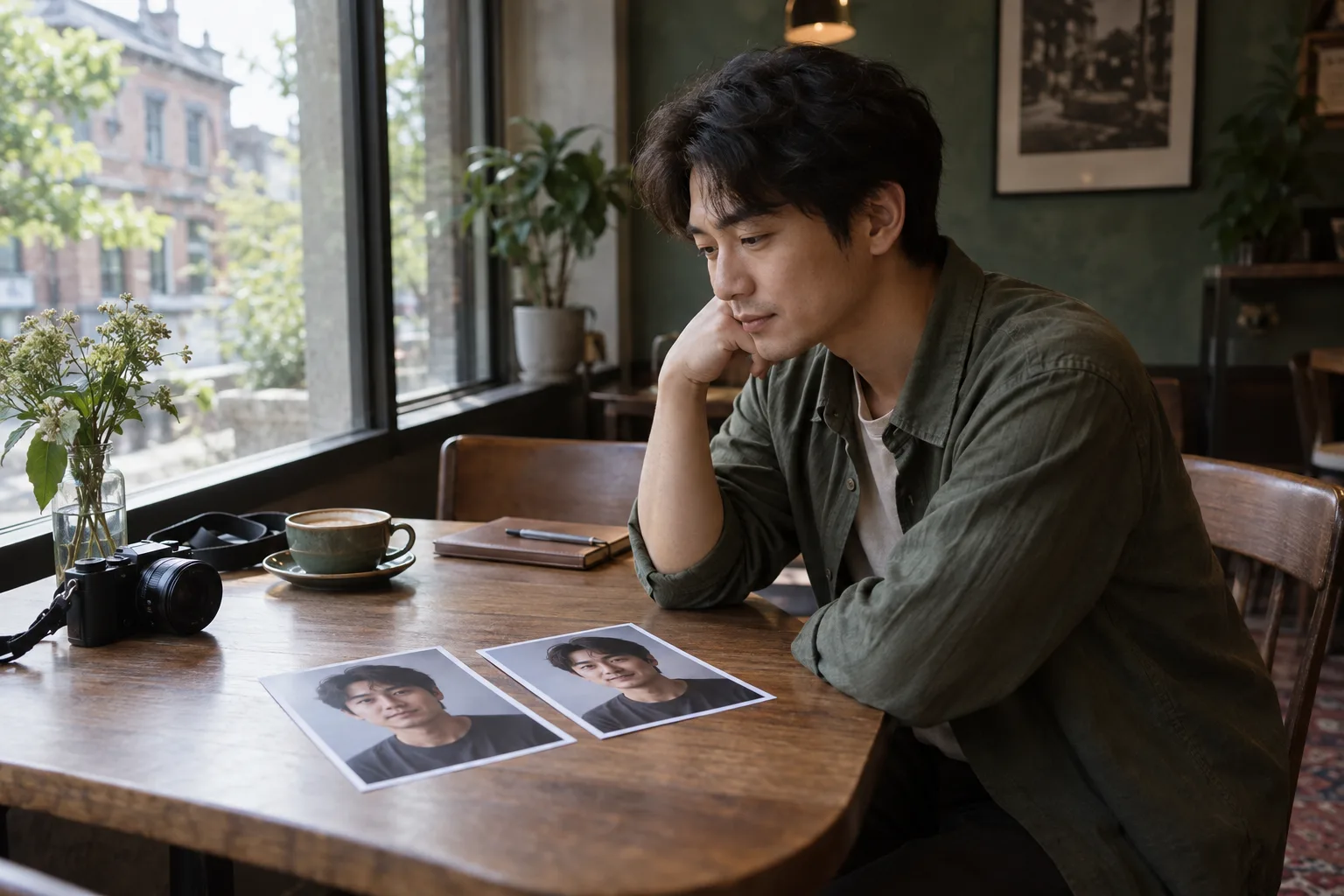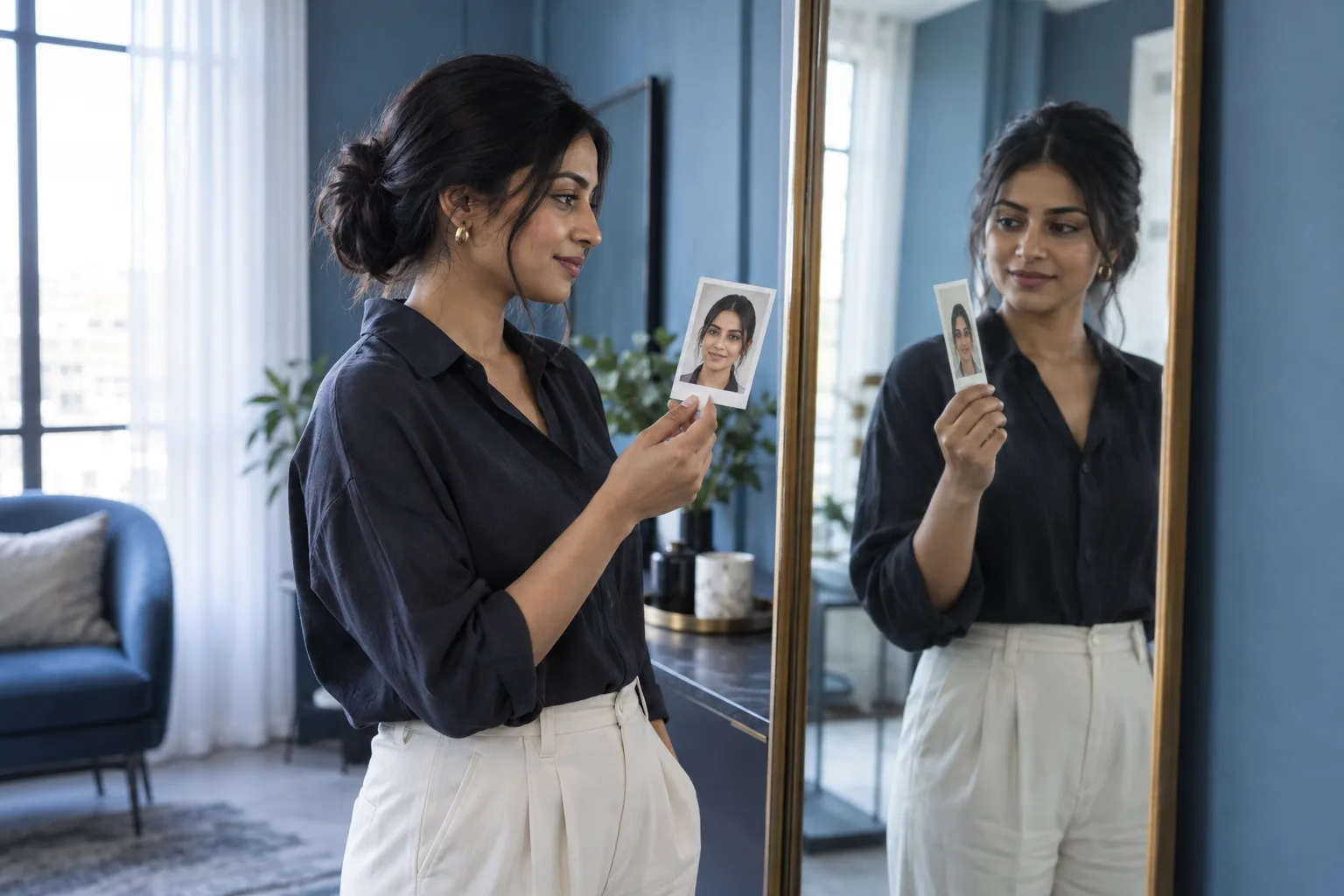
If your face looks asymmetrical in photos but familiar in the mirror, the difference often comes from a reversed view, close camera perspective, lighting and one frozen expression. A photograph is not a neutral measurement of your face. Small natural differences between sides can become more noticeable when the orientation changes or one cheek is closer to a phone. Before deciding that a feature has changed, compare one ordinary, unfiltered portrait taken from a comfortable distance with the version you are used to seeing in the mirror.
This guide is about explaining a specific visual puzzle, not grading symmetry or promising to fix a face. You will learn what a mirror reverses, why a close selfie can alter proportions, how to set up a fair photograph, and when an apparent difference deserves attention outside a photo. A face-analysis tool can describe what is visible in an image, but it cannot turn one frame into an objective judgment about your appearance or health. The aim is a calmer, more accurate interpretation.
Why a face looks asymmetrical in photos but normal in a mirror
The mirror gives you a moving, familiar orientation of your face. A standard rear-camera photograph usually shows the opposite orientation from the one you have practiced recognizing for years. A small difference in brow height, smile direction or hair part may suddenly appear on the unexpected side. That surprise can feel like a new defect even though nothing physically changed. A 2024 peer-reviewed study found that people rated non-reversed images of themselves as less familiar and less pleasant than mirror-reversed images; that pattern differed for familiar friends.
Reversal is only one factor. You also look into a mirror at a changing distance, with both eyes combining depth and with an expression you can adjust continuously. A photograph flattens one moment into a fixed rectangle. It may be taken under harsher light or with a phone held below eye level. Do not treat whichever version feels most comfortable as the single truth. Ask which capture conditions created the difference, then look at the entire face rather than one eyebrow in isolation.

What the selfie camera may reverse
Many front-camera previews behave like mirrors so that moving your hand to one side of the screen feels intuitive. A saved photograph may keep that orientation or flip it, depending on the device and settings. A rear-camera portrait may show a different orientation again. If two pictures disagree about which side your hair part or mole appears on, check whether one is reversed before interpreting facial structure. Use a non-sensitive landmark such as the position of a collar button or a familiar hair part to identify orientation.
Do not repeatedly flip an image until you find the version you dislike most. The purpose of checking orientation is to remove confusion, not to choose a harsher verdict. Keep one original file, note whether the preview and saved image match, and use the same orientation when comparing later photos. Mirroring swaps left and right in the image; it does not create or remove a real asymmetry. Nor does a non-mirrored picture show how someone experiences your face during a moving conversation.
Camera distance changes apparent proportions
A selfie taken at arm's length is a near-field perspective. Parts nearest the camera can appear larger relative to the ears and outer jaw. If the phone is even slightly off-center, one cheek or eye can be closer than the other and may look wider. A PubMed-indexed digital-photography study measured midface distortion at short selfie distances with smartphones and cameras. It did not show that a phone can diagnose facial asymmetry; it showed that capture distance matters when interpreting a face in a photograph.
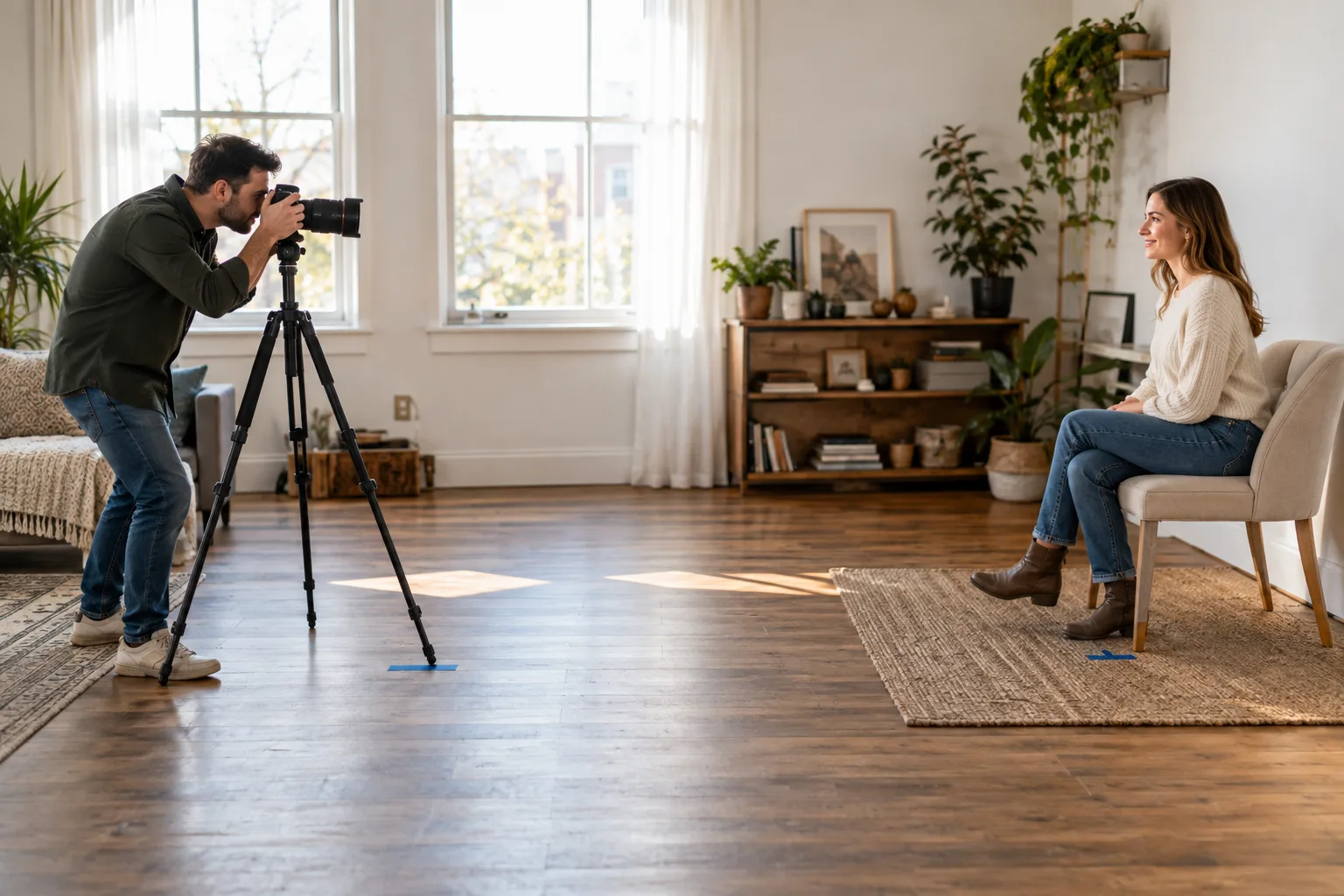
For a more representative portrait, place the camera at roughly eye level, step back several paces, use a timer or ask a friend, then crop the image afterward. Keep the head level and face the camera without forcing the chin into an unnatural position. You do not need an expensive lens or a mathematical measurement. You need enough distance that a tiny movement no longer makes one side dominate the frame. If the image changes substantially after this correction, the original selfie was poor evidence for a permanent facial difference.
A small turn or tilt makes two sides look different
Perfectly straight posing is difficult. A slight turn brings one cheek forward and hides a little of the other. A tilted head shifts the eye line; a lifted chin changes the jaw-to-neck transition. These effects can look like structural asymmetry when you inspect a frozen photo closely. Before drawing conclusions, locate the center of the nose, the direction of the shoulders and how much of each ear is visible. Unequal ear visibility often means the head or camera is not centered.
Do not correct this by holding your face rigidly. Instead, take a small set of relaxed images from the same spot, with a comfortable neutral expression. A consistent setup lets you see which impressions persist across frames and which disappear with a tiny change in pose. This is different from hunting for the most flattering angle. It is a basic quality check. A real-life face is seen in motion and from many viewpoints, so one tilted still should never carry the full interpretation.
Light can draw an uneven border that is not anatomy
Hard light from one side makes one cheek brighter and the opposite side darker. A shadow under one eye or along one jaw edge can suggest a different shape even when the underlying face has not changed. Overhead light can deepen the eye area; a nearby window may light the near side much more strongly. A phone may then expose for the bright side and make the shaded side look narrower or heavier. This is an optical reading problem, not proof of a new feature.
For a fair check, face a broad window or use soft light from near the camera. Move away from a small, harsh bulb and avoid a filter that reshapes skin or features. Look at the same face under two ordinary lighting conditions before declaring that one side is fundamentally different. Neither setting is a laboratory standard; the point is to identify the role of shadows. For style or analysis decisions, use the version that reveals both sides clearly without dramatic contrast.

Expression and timing matter more than a perfect line
A photograph freezes a fraction of a second. One eye may be starting to blink, one corner of the mouth may move first, or a brow may lift while you listen. An expressive face is not required to be bilaterally identical in every frame. Compare a few natural moments, not a burst of fifty pictures searched for the least balanced one. If the asymmetry appears only in one frame but not the next, timing is a more plausible explanation than permanent anatomy.
The comparison should stay at normal viewing size. Zooming until one eye fills the screen removes the neighboring features that make a face intelligible. It also turns tiny pixel differences into a dramatic event. Use a whole head-and-shoulders frame. Ask whether the difference remains obvious in ordinary light at normal distance, and whether it matters to a real decision. The goal of a face-analysis guide is to improve interpretation, not to train constant inspection.
Use a three-photo check instead of endless selfies
If the question still bothers you, make one controlled set: a relaxed front portrait from several steps away, a second frame with the same camera and light, and one natural three-quarter view. Keep the original files and note whether the front-camera preview was mirrored. Avoid beauty filters, face-warp tools and screenshots that may be flipped again. Compare the whole image at the same size. If a difference changes sides or intensity between nearly identical frames, investigate orientation, pose and light first.
A free symmetry test or FaceScore can only read the particular image supplied to it. It cannot separate photography from anatomy by magic, and a higher number is not proof of a better face. If you use a tool, select one clean image, read any explanation cautiously, and do not submit a stream of slightly different selfies until you get an answer you like. The earlier symmetry guide explains what a visual comparison can and cannot tell you; this guide focuses specifically on why the mirror-to-photo jump feels so surprising.
Know when a change is more than a photo effect
Stable, slight left-right differences are ordinary. An image alone cannot diagnose their cause. A new or rapidly developing change in facial movement, a suddenly drooping mouth or eyelid, weakness, numbness, pain or other concerning symptoms is a different situation from a disappointing selfie. Seek prompt medical evaluation for sudden changes rather than trying more angles, facial exercises or a beauty app. This article offers photo interpretation, not clinical screening or treatment advice.
For a non-urgent concern that appears consistently in person and in ordinary photos, discuss it with an appropriate health professional rather than relying on an online score. Conversely, if your concern appears only after flipping, zooming or taking very close selfies, a calmer review of the image setup may be enough. Avoid irreversible appearance decisions based on one strange frame. A haircut, lighting adjustment or better camera setup can alter presentation, but none should be sold as a way to correct a presumed medical condition.
Let the full face, not one frozen side, guide the conclusion
Return to the simplest comparison: one mirror view you recognize and one well-made portrait in a known orientation. Notice what changes when you flip the portrait, step back from the camera, center your head and soften the light. The result will often show that several modest image effects combined to create an apparently large difference. You may still have natural asymmetry, as every expressive face can, but you no longer need to mistake every photographic artifact for a fixed trait.
If a practical style question remains, choose one reversible action such as changing how hair frames the forehead or taking future photos from a repeatable distance. You do not need to chase exact symmetry or prove your appearance to an app. A useful face-analysis habit ends when it gives you enough context to decide calmly, not when every pixel has been inspected. The mirror and photograph are different views of the same person, and neither is a measure of human worth.