
Almond vs round eyes is mainly a question about the visible opening between the lids: an almond description suggests a more elongated, tapering outline, while round describes a more rounded-looking opening. These are everyday descriptions, not two exclusive anatomical boxes or a ranking. Observe relaxed eyes, keep the whole face in view and separate the opening from the lid fold before choosing a label.
Perhaps a frame you like partly hides your eyes, and two different photographs leave you unsure which eye-shape advice to follow. This app-assisted guide starts with that practical uncertainty. You can use MogRise for broader explained face analysis and a small planning decision, without assuming that it calculates an eye-shape probability or tells you which eyes you ought to have.
Almond vs round eyes: describe the opening first
Follow the upper and lower lid edges around the visible opening, not the eyebrow, dark shadow or outer edge of makeup. Does the opening look elongated with tapering ends, more rounded through the middle, or somewhere between? Use a tentative sentence: the opening looks softly elongated here. You do not need to declare a permanent type before deciding whether a frame feels comfortable.
The FISWG morphological feature list, version 2.0 of 11 September 2018, lists opening shape separately from angle, lid details and iris position. It is identification vocabulary, not an attractiveness standard or MogRise endorsement.
For your own notes, keep the observation smaller than the label. Instead of writing round eyes are wrong for this frame, write the upper rim overlaps the area I wanted to leave visible. That sentence gives you something concrete to discuss with an optician. It also leaves room for liking the same frame despite the overlap. Describing a feature does not create an obligation to disguise it, and a mixed impression is not a failed result.

Do not turn the white around the iris into a pass mark
Many beauty guides suggest checking whether you can see white above or below the colored iris. That may help explain what a particular picture looks like, but it is not a universal yes-or-no classifier. A picture caught while looking upward or opening the eyes deliberately wider does not answer the same question as a comfortable forward gaze. Keep that difference in your notes rather than forcing agreement between the pictures.
Try the ordinary-language version: in this reference the upper lid overlaps the iris, or this image shows more space below it. Stop before attaching an ideal amount, a ratio or a personality story. You are recording visible relationships, not diagnosing the eye or measuring the orbit. If the outline is partly obscured, unknown is more honest than filling in the missing edge. Do not pull a lid, hold your eyes open or alter a photograph to make a preferred category fit. A useful styling choice should not require a strained expression or repeated inspection of tiny crops.
Keep four different questions apart
Opening outline, lid-fold visibility, corner direction and distance between the eyes are different questions. An elongated-looking opening can also have a partly hidden upper crease. A rounded impression does not tell you whether the outer corner slopes upward, and neither description establishes how far apart the eyes sit. Combining all of those observations into one label usually makes a practical conversation less clear, not more informative.
Suppose you are deciding whether to keep a familiar pair of glasses. You might notice that the frame's upper edge covers the crease, while the opening itself remains visible. That is a frame-and-visibility observation, not proof of a different eye type. Our hooded-versus-deep-set guide addresses the separate fold-and-depth question. Use that distinction only if it answers something you genuinely need to know. You do not have to build a complete catalogue of your eye region before making one everyday decision, and you need not make the two sides match a single word perfectly.
Choose one relaxed reference, not your widest-eyed picture
The FISWG capture guide, version 2.0 of 10 May 2019, discusses neutral expression, open eyes, clear visibility and illumination for identification images. Here we use only those visibility principles, not a clinical protocol or proof that a beauty classifier is accurate.
Stand or sit comfortably and look toward an eye-height camera, with your brows resting normally. Use broad light that lets you see both lid edges, and keep enough of the head in view to recognize the whole expression. Avoid a very close selfie, deliberate squint or surprised pose. Let an ordinary blink finish before choosing the reference. One usable front view is enough for this outline question; a side view can provide broader face context, but it cannot replace the visible frontal opening.
Keep the original image rather than sharpening a tiny eye crop or applying a filter. If glare from glasses hides the boundary, choose another comfortable lighting position instead of guessing through the reflection. These are practical choices for an understandable reference, not a recipe for a calibrated measurement. If you already have a suitable image, there is no reason to begin a new photo session.

Bring a decision to MogRise, not a demand for an ideal
Before opening MogRise, write the practical question: I want to know whether this frame leaves my eye region visible, or I want to understand why an eye-shape label does not match what I see. Its broader front-and-profile review and explained analysis can help organize observations and a limited set of priorities. This article does not claim a dedicated almond-versus-round detector, an anatomical eye measurement or a validated probability for a shape category.
Read an explanation as a prompt to check your actual decision, not as permission to correct an ordinary feature. A PSL or FaceScore can supply planning context; it is not objective human worth or a prescription for your eyes. MogRise is free to download with in-app purchases. That does not mean every feature or unlimited analyses are free. If a general result does not answer the outline question, leave that question open. Another scan is not automatically the missing step, especially when the choice is simply whether you prefer a familiar frame.
A useful note can contain a mixed answer
Consider a hypothetical note, not a product test: my opening looks elongated in the relaxed front view; it looks rounder in the laughing photo; I prefer the frame that stays comfortable while I talk. That note separates the reference, the expression and the decision. It does not say the eye changed anatomically or that one photograph revealed a truer level of attractiveness. The description is useful because it remains tied to a real choice.
If the two sides look a little different, describe each only as far as the decision requires. One label for both eyes is not a prerequisite for choosing glasses. Nor must every casual photograph repeat the reference impression. You can write uncertain at this angle and move on. Do not sort dozens of images into good-eye and bad-eye folders or recruit votes on which type wins. The aim is clearer language and less unnecessary checking, not a more elaborate system for evaluating your appearance. Keeping the present arrangement can be a fully reasoned outcome.
Test a frame for ordinary use, not an opposite-shape rule
If glasses prompted the question, try the pair you already own in normal conversation. Check whether they sit comfortably, stay in place and allow the visibility you want. A frame does not have to oppose your eye shape, and a round opening does not require an angular rim. Start with what you like, not a chart that presents one combination as universally correct. Our glasses-fit guide covers the broader choice of a frame; this exercise is only about explaining one observation.
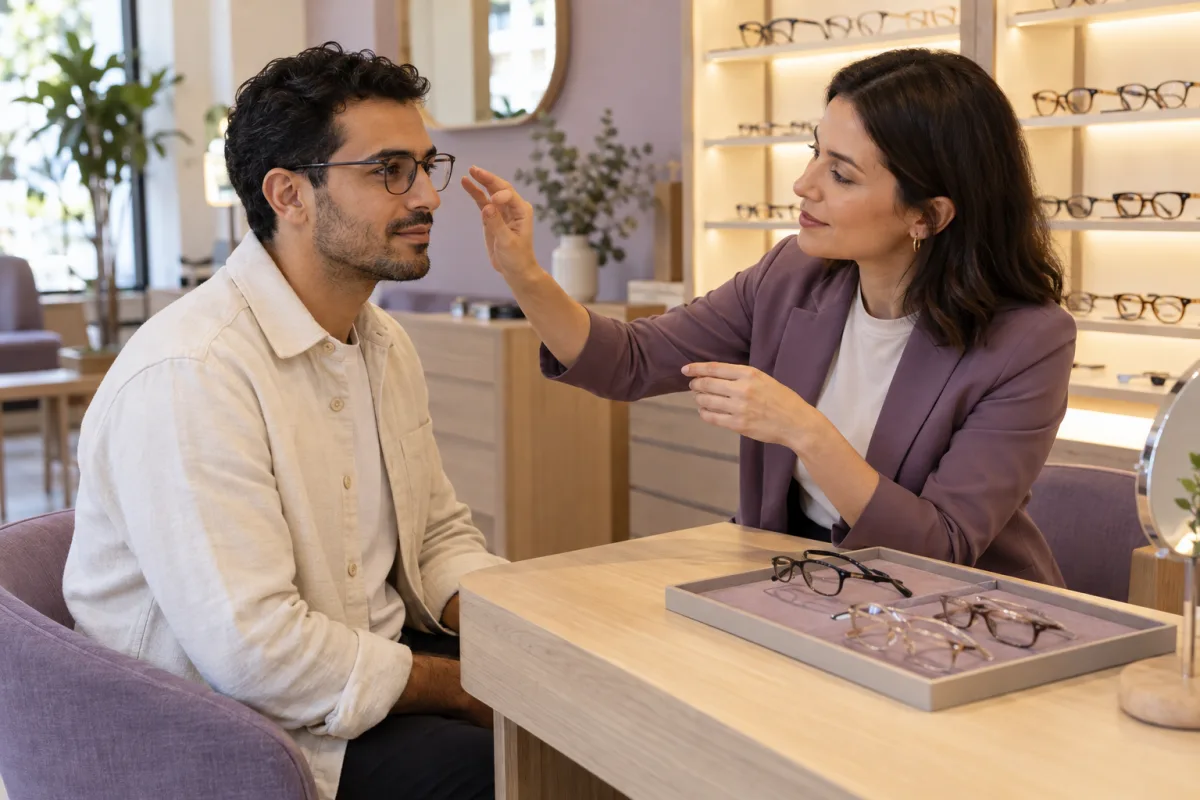
An optician can help with how a frame sits. Give a bounded request: I like this pair, but I want to check the upper rim and comfort without changing everything else. Do not bend the frame yourself or change a prescription to follow a style category. If there is no comfort or practical problem, no purchase or adjustment is required. Keep the comparison small enough to remember why you started it. You are choosing an accessory for everyday wear, not trying to turn the opening between your lids into a different anatomical shape.
Finish when the choice is clear enough
Write one sentence containing the observation and the next step, or the decision to do nothing. For example: the opening looks softly elongated in this reference, and I am keeping the comfortable pair I already enjoy. Close the image and return to what you were doing. There is no need for a final exact label, a preferred ratio or a fresh score before the decision counts.
This is a descriptive styling exercise for familiar features, not a way to explain new eye symptoms. A new or persistent concern belongs with an appropriate healthcare professional, not an appearance classifier. If checking becomes upsetting or difficult to stop, take a break and seek support rather than collecting more labels. Understanding the difference between an opening, a fold and a frame should make the task smaller. The useful result is a manageable choice that leaves you free to spend attention elsewhere.