
Forehead shape describes more than the amount of skin visible above your brows: a front view shows the exposed area and hair boundary, while a profile helps you describe the surface contour. Height, width and slope are different observations. Name the one you actually mean before changing your hairstyle or interpreting a face analysis. None of them establishes an ideal forehead or your value as a person.
Perhaps your hair looks fine from the front, but a side photograph leaves you wondering whether your forehead is rounded or slopes backward. That is not automatically a request for a smaller forehead, a different hairline or treatment. This app-assisted guide starts with that narrower question. MogRise can supply broader front-and-profile planning context; the descriptive exercise here is not a claim that it measures a forehead angle or determines which anatomy you should have.
Forehead shape: first choose the question
The FISWG morphological feature list, version 2.0 of 11 September 2018, separates relative forehead height, width and profile contour, and treats hairline details separately. It is an identification reference, not a beauty standard or an endorsement of MogRise. That distinction helps keep an everyday observation specific.
Begin with a sentence rather than a category: I notice the exposed area above my brows, or I notice the line of the forehead in profile. If the concern disappears when a loose fringe is moved, you may mainly be describing coverage. If you are following the outside silhouette in a side view, coverage alone is not the entire question. Avoid jumping from a broad word such as big to a proposed correction. Big might mean tall, wide, prominent, simply uncovered, or unfamiliar in that picture. Each meaning leads to a different conversation, and sometimes to no useful change at all. Naming uncertainty is a valid first result.

Visible height is not a measurement of the surface
For this practical exercise, visible height means the exposed span between the brow area and the hair boundary you can actually see. It is not a clinical dimension. Loose front hair can hide part of that span; a hairstyle swept back can reveal it. Before comparing two impressions, ask whether the same area is exposed in both. Otherwise you may be comparing a styling choice with a facial description without noticing the switch.
Do not fill in an invisible hair boundary or count fingers to decide whether your forehead passes a rule. A finger-width convention does not settle what you like or what an ordinary photograph measures. You can write boundary partly hidden and stop there. If the question concerns a genuinely new change in your hair or skin, separate that concern from this styling exercise and discuss it with a qualified professional. An appearance category is not a diagnosis. For a familiar, stable feature, describing the visible area is enough; no centimeter target needs to follow.
Read a profile contour without tracing a perfect angle
Look at the broad forehead silhouette in a relaxed side view. Everyday descriptions such as gently curved, more upright or sloping backward are sufficient. Do not force the entire surface into one straight line if it visibly curves. Nor should the small transition above the brow become a definition of the whole forehead. Keep the nose, eye region and full head visible so the word you choose still refers to the right place.
A front portrait cannot answer every question about a side contour. Equally, a profile cannot establish how much width you see from the front. If the two views seem different, that is not necessarily a contradiction or a reason to seek a third category. They may simply answer different questions. Avoid drawing a sharp angle over a casual photograph and treating the number as bone anatomy. This guide offers no preferred slope, gender rule or personality interpretation. A rounded surface is not inherently better than a straighter-looking one, and neither makes a style decision compulsory.
Keep a reference that makes the region visible
The FISWG capture guide, version 2.0 of 10 May 2019, discusses even illumination, relaxed expression, clear visibility and camera position for identification images. We borrow only that limited visibility principle, not an identification protocol or validation of attractiveness scoring.
Use a comfortable whole-head view near eye height, with broad light and enough distance to avoid leaning into a close selfie. If you also want a profile, turn comfortably rather than twisting your eyes toward the camera while holding the rest of your head sideways. Keep your brows relaxed instead of lifting them to expose more skin. Move loose hair only enough to see the relevant region, without pulling it tightly. One usable reference in each needed view is sufficient for this question. Save the originals rather than using a filter that redraws the hair boundary. If glare, deep shadow or a half-hidden forehead prevents a clear description, record that limitation instead of taking a long sequence of nearly identical pictures.

Use MogRise for context, not an invented forehead metric
Start a MogRise review with the question you already named. You might write: I am considering how my front hair sits, not trying to change the forehead surface. The how-it-works page describes the broader explained analysis and planning workflow. Read that context beside your own observation instead of turning a general FaceScore into a dedicated forehead verdict. We do not claim the app calculates an anatomical slope, predicts a perfect hairline or validates a required forehead shape.
MogRise is free to download with in-app purchases; that does not mean unlimited free analyses or every feature free. You do not need another scan to understand the difference between coverage and contour. A useful next step can be one small hair-framing experiment, a clear question for a stylist, or no change. If the explanation does not answer your specific observation, leave it unanswered rather than inventing a measurement. Scores can organize a plan, but they are not objective human worth and they should not overrule a comfortable preference you already have.
Try coverage, without pretending to change shape
If your actual preference concerns exposure, gently arrange your existing front hair in one comfortable alternative. For example, let a loose section sit slightly forward instead of brushing every strand back. This is a small presentation experiment, not a prescription that foreheads should be hidden. Do not cut a fringe, pull hair tightly or buy a stronger product just to complete the exercise. Work within what your hair already does comfortably and return it to the original position whenever you prefer.
Look at the whole face in ordinary use rather than enlarging only the forehead. Ask whether the arrangement feels comfortable, stays out of your eyes and fits the time you want to spend each morning. A style that works only while held in place for a photograph may not solve an everyday problem. Keep the other choices steady so you can explain what you liked. If nothing improves, that is useful information too: the question may not need a styling response. The forehead surface has not changed merely because more or less of it is visible.
Give a stylist a bounded request
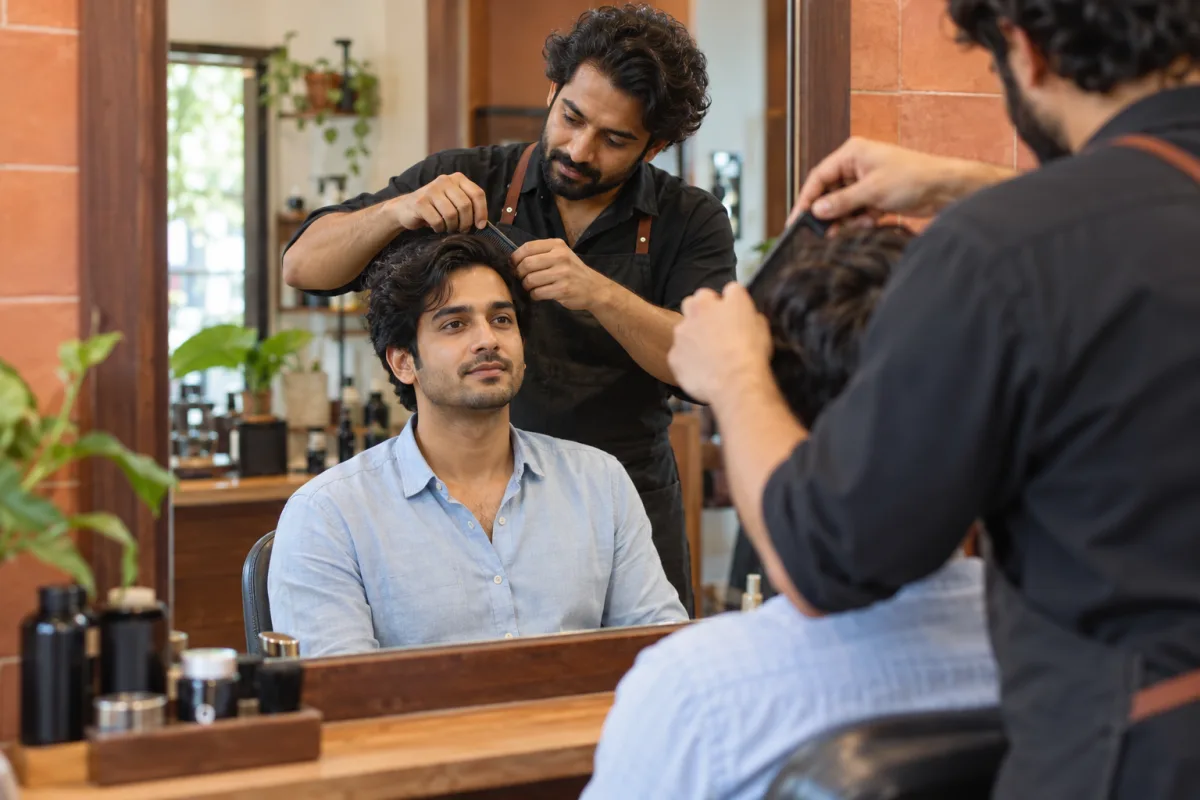
A useful consultation separates the observation from the request. Say: I want to try a softer edge of front hair while keeping my current length, rather than fix my forehead. Explain what should stay: the natural hair boundary, a comfortable feel and a routine you can repeat without effort. The existing big-forehead haircut guide addresses the separate question of choosing a cut; you do not need a new cut merely to describe a profile contour.
Ask the stylist to demonstrate any proposed arrangement before agreeing to cutting. Reference images can communicate a texture or a degree of coverage, but another person's forehead is not a target for yours. Tell the stylist if the suggested look needs more daily attention than you want. A consultation can end with keeping the present style. Do not let a broad label authorize a stronger intervention you never requested. An ordinary styling conversation should make your choice clearer, not turn one photograph into a list of defects or commitments.
Finish with one sentence and a stopping point
Record what you observed, what you could not establish, and what you chose. For example: the side contour looks gently curved; this picture does not measure its angle; I will keep my normal hair arrangement. That is a complete result. It is more useful than collecting several competing shape labels or checking whether every new photo gives the same impression. Close the comparison once it has answered the everyday decision you brought to it.
This guide is not a way to assess a new lump, pain, injury or another health concern. Bring new or persistent changes to an appropriate healthcare professional, rather than asking a face-analysis score for an explanation. If appearance checking becomes distressing or difficult to stop, step away from the images and seek support. For an ordinary stable feature, no corrective action is required. Understanding which question concerns surface contour, visible height or hair boundary lets you keep a small choice small and return your attention to the rest of your day.