

Mustache styles work best when their width, bulk and lip edge fit the hair you actually grow and the maintenance you want. Start with a modest natural shape, decide whether hairs interfere with your upper lip, and change one boundary at a time. A face-shape label cannot choose that for you. Clear front and profile photos can help organize the decision, but neither a photo nor an appearance score makes one style objectively best.
Perhaps your mustache looks fine in the mirror but feels untidy when you eat, or it seems much heavier beside clean cheeks than beside stubble. Those are specific questions with different answers. This guide separates shape from hair length, shows how to preserve useful growth while tidying an edge, and explains where MogRise can support a small plan. It is not a growth treatment, a virtual try-on promise or a ranking of faces.
Mustache styles begin with existing growth
Look at the whole strip above your upper lip before choosing a named style. Notice where hairs are dense, where they separate naturally in the middle, how the outer ends grow, and whether individual hairs point downward or sideways. Observe without pulling the skin or pressing hairs into an artificial arrangement. A natural central gap is not automatically something to repair. Your starting point is useful information, not a deficiency.
A short natural mustache keeps much of the existing outline and primarily tidies strays. A fuller shape keeps more vertical bulk and usually asks for more attention at the lip. A deliberately narrow pencil-like shape removes more surrounding growth and leaves little room for an inaccurate edge. Longer turned ends require sufficient length and a styling routine; they are not simply a short mustache with a different name. These descriptions organize options, not prescribe them.
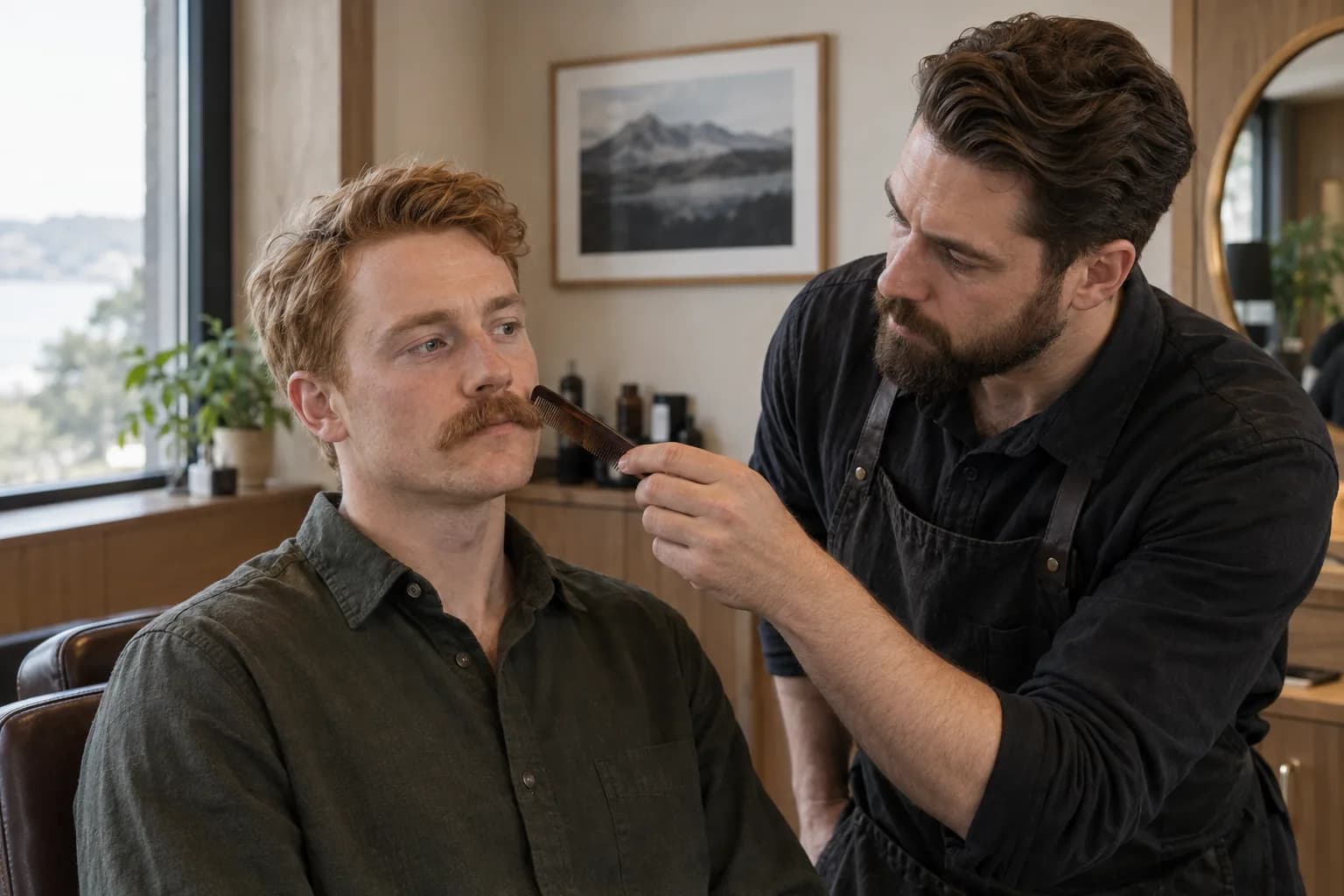
Choose two realistic directions rather than collecting twenty reference faces. One could be your current outline with a cleaner lip edge; the other could be slightly less bulk while retaining the same width. If the reference depends on dense growth you do not have, borrow its maintenance idea rather than its exact silhouette. A barber can explain what your existing hair can carry before you remove anything.
Separate width, bulk and lip clearance
Width is where the shape ends toward the mouth corners. Bulk is the amount of hair seen above the lip and projecting forward. Lip clearance concerns the hairs that reach the lip or get in the way during ordinary activities. These variables interact, but they are not interchangeable. Cutting the outer ends will not necessarily solve hairs falling into your mouth. Shortening every hair may solve interference while removing much more shape than you intended.
Name the actual nuisance in a sentence. For example: the center reaches my lip when I drink, while the ends sit comfortably. That points toward inspecting the center boundary, not narrowing both sides. Another person may like fuller coverage but dislike the time spent arranging the ends. Their useful change might be a simpler outline rather than an extremely short setting. The right question is practical and local.
Keep neighboring facial hair in view. A standalone mustache against clean cheeks can read differently from the same strip beside short stubble, even when its length has not changed. If you want to compare that relationship, use the site's short-stubble guide for the separate beard-length decision. Do not trim the mustache, shave the cheeks and change your haircut in the same experiment: afterward you will not know which change helped.
Make one honest visual reference
Use soft ordinary light and a camera around eye height at a comfortable distance. Include the full head and shoulders rather than cropping tightly around the mouth. Hold your usual relaxed expression; a stretched smile changes the lip boundary you are trying to inspect. Take a front view and a true side view if the forward projection matters. Keep filters and beauty smoothing off, and do not treat a very close wide-angle selfie as your main reference.
The first photograph records your current arrangement, not a before picture promising a transformation. Keep the hair dry and arranged as you normally wear it. If you have just combed it into an unusually polished shape, say so in your own note. A reference should help a barber or your future self understand what normally happens. It is not a contest to create the most flattering image.
MogRise can support the broader planning process through clear front and profile photos, an explained analysis and a small set of priorities. Bring a question such as whether the upper-lip frame needs less bulk, not a demand for an ideal facial score. Do not assume the app measures mustache hairs, simulates a specific cut or predicts which style others prefer. Its useful role here is context for a decision you can check in real life.

Inspect the edge before shortening everything
Begin with clean hands, a clear mirror and tools you know how to use. Read the manufacturer's directions for the actual trimmer and attachments; numbers on different guards do not always create an identical visible finish. Gently comb the hair into its usual direction and inspect the lip edge with your mouth relaxed. Do not cut while speaking, moving quickly or trying to watch a phone at the same time.
If you are new to shaping, first remove only an unmistakable stray that interferes with comfort, or ask a barber to demonstrate the boundary. Keep an unfamiliar blade away from the lip and nostrils. Rounded grooming scissors can still injure, so they are not a reason to work carelessly. Preserve the outline when unsure. You can make a smaller follow-up cut; putting removed hair back requires waiting.
Step away from the magnifying view after a small adjustment. Check at normal conversation distance and let the hairs settle. Resist matching every tiny difference by taking another piece from the opposite side. Real growth is not a drawn symmetrical line. When the edge is comfortable and the whole shape looks intentional to you, stop. Repeated corrective cutting is more likely to erase a useful mustache than improve the original practical issue.

Care for the skin, not only the outline
A tidy silhouette is not enough if the area underneath feels irritated. The American Academy of Dermatology's facial-hair guidance emphasizes gentle cleansing, appropriate moisturizing and clean grooming equipment. Use that as a comfort baseline, not evidence that a particular mustache shape improves attractiveness. Keep product away from the inside of your mouth and follow its label. Adding several new formulas at once makes an unpleasant reaction harder to trace.
Avoid using wax as a substitute for solving a shape that never suits your routine. If a small amount helps longer hairs sit comfortably, assess its feel and whether you can wash it away easily. If you dislike the residue or repeatedly touch the area to rearrange it, a simpler shape may be more practical. A shiny or stiff finish is not proof of healthy hair, and a natural finish does not mean the style lacks intention.
Do not keep grooming over sore, broken or increasingly irritated skin. Pause the experiment and seek appropriate professional advice for persistent or concerning changes. A photo analysis cannot diagnose that problem. The styling decision can wait. The broader beard-care article may help organize ordinary maintenance, but it should never turn discomfort into another feature to rate or a reason to try increasingly aggressive products.
Budget for ordinary mornings
Choose the amount of upkeep before deciding on elaborate ends or a very narrow outline. Think about a rushed workday, a meal away from home and the tools you will actually have available. A style that only sits correctly after careful arranging may be enjoyable if that is your hobby. It may be a poor fit if you want to wash, comb and leave. Neither preference is more mature or more masculine.
Set your review around behavior rather than a universal trimming calendar. Notice when the center begins interfering, when the outline no longer feels tidy and how long care takes. Different hair directions and chosen lengths mean that somebody else's schedule is not yours. Avoid repeatedly trimming on consecutive days simply because a photograph reveals a new stray. A stable routine should reduce attention, not require you to monitor the mouth all day.
If maintenance exceeds your budget, simplify one feature. You might keep natural width and shorten excessive projection, or retain bulk but stop trying to curl the ends. Describe the compromise to a barber if you are unsure how to preserve it. Do not buy a collection of tools before confirming that you like wearing the mustache at all. Comfortable existing equipment and a clear plan are often a better starting point.
Review comfort and the whole face
After the small change, spend time eating, drinking and speaking normally before judging another photo. Those activities reveal whether the specific problem improved. Compare a similarly framed reference later, but do not seek a score increase as confirmation. A mustache can look different in a side shadow without changing its practical fit. If a change makes your morning easier while preserving a shape you enjoy, that is a meaningful outcome.
Use an ordinary viewing distance and your usual clothes when discussing the result. Ask a trusted person a narrow question such as whether the ends look deliberate, rather than asking them to rate your attractiveness. Their taste can differ from yours. You may keep the original style after learning that the nuisance was a few hairs at the center rather than the entire silhouette. A decision to make no further change is a valid conclusion.

Leave with one maintainable choice
Write down the shape you are keeping, the single boundary you adjusted and the reason. Keep the note concrete: preserve the natural ends, clear interfering center hairs, and review when drinking becomes uncomfortable again. If you used MogRise, keep only the analysis context relevant to that choice. The app is free to download; that does not mean every feature or unlimited use is free. Check the current access details before relying on a feature.
Your next action can be a careful maintenance visit, a simple daily comb or leaving the mustache alone while you decide. Do not force a narrow pencil shape, dramatic ends or complete shaving merely to match a reference. The successful plan is one you understand, can repeat safely and genuinely want to wear. Facial hair frames a face; it does not change your human value or create an obligation to improve every visible detail.