
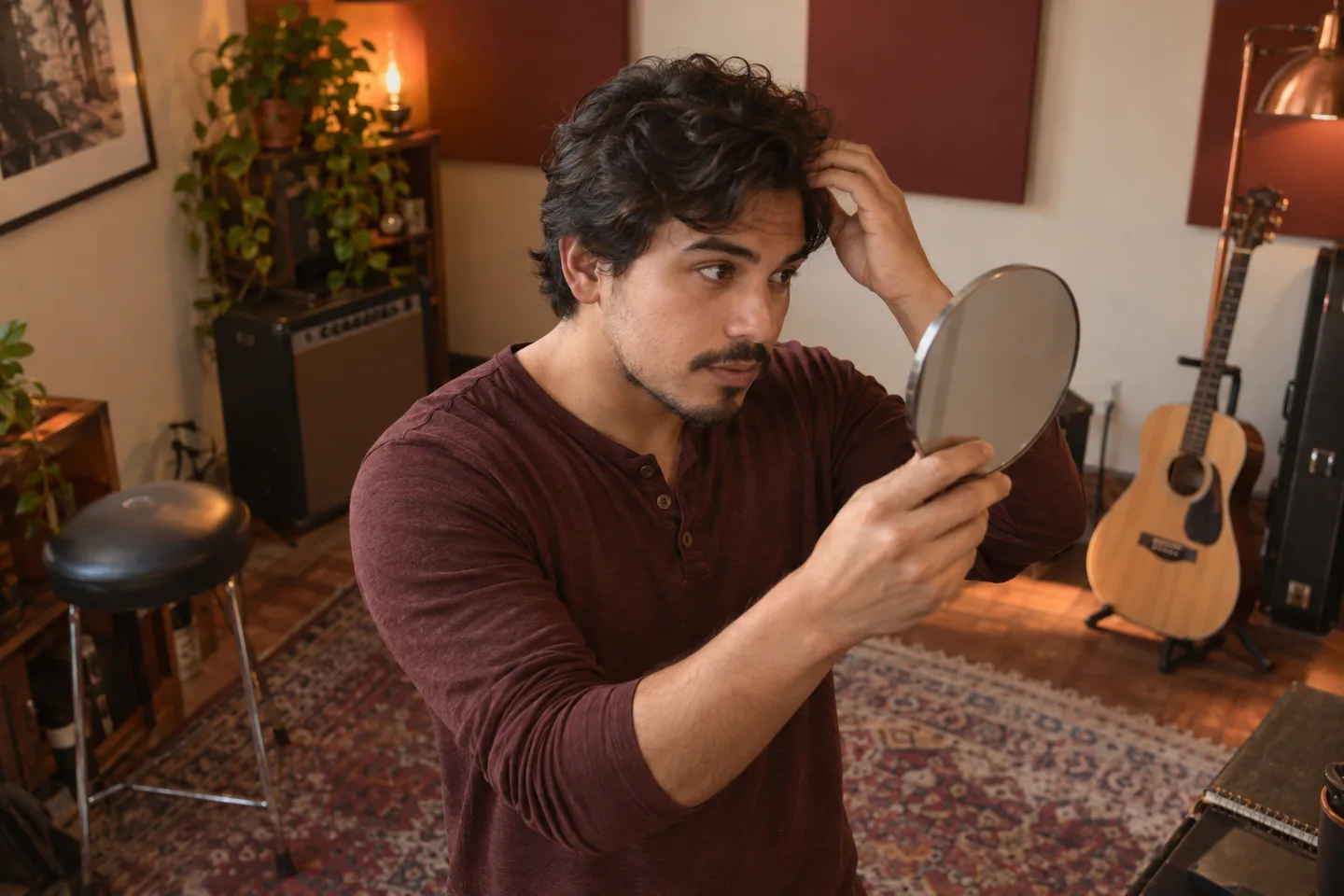
A hair cowlick is best managed by working with the direction of a persistent lifting or separating section, rather than forcing every strand flat. Locate the section, try a gentle local reset and decide how much daily styling you actually want. A haircut can accommodate the pattern; a comb, product or face-analysis score cannot promise to permanently change its growth direction.
The useful question is not whether your hair is defective. It is whether the front tuft, crown split or lifted patch needs a different routine or a more suitable cut. This guide starts with that everyday decision. MogRise can help organize clear front and profile references, explained observations and a small priority, but your own hair behavior and a barber's hands-on assessment remain essential.
Locate the hair cowlick before choosing a fix
Start with clean hair in its ordinary dry state, without a heavy layer of styling product. Let it settle after removing a hat or brushing. Note where the roots seem to change direction and which section repeatedly rises or separates. The front hairline and the crown are different locations. A front tuft affects the fringe; a crown pattern affects the top or back silhouette. One solution need not work for both.
Use two mirrors or ask someone you trust to look at the back. Observe gently rather than dragging a comb over the scalp. A temporary bend after sleeping may relax with a simple reset, whereas a recurring direction may keep returning. You do not need to assign a scientific label to every strand. A practical note such as 'the right front section lifts when it dries' is enough to begin.
Visible scalp at a swirl is not a diagnosis, and this styling guide cannot tell whether there is hair loss. A face photo or crown snapshot cannot settle a health concern. If you notice a new or persistent change that worries you, seek professional assessment instead of disguising it with more product. Keep the styling question separate from the medical question.
Choose the outcome, not an impossible flatness
Decide what you want in normal viewing conditions. Perhaps the fringe should stay out of your eyes, the back should look less sharply lifted, or you want a soft textured shape that includes the tuft. Those outcomes are more useful than requiring every hair to lie perfectly smooth. A small amount of movement can belong to the style rather than being a failure to correct.
Set an effort budget before buying anything. Someone willing to spend a few minutes after washing has different options from someone who wants to towel-dry and leave. Include time for cleaning tools and removing product, not just the first successful moment in a mirror. A look that needs constant checking may not be worth keeping, even when it photographs neatly at home.
Do not choose a direction solely because an online face-shape rule says it is flattering. Hair texture, length, root behavior and preference can make that instruction impractical. Write one goal and one limit: a softer front section, without extra heat or repeated restyling during work. This gives a barber a concrete problem and makes the home test easier to judge.
Try one gentle reset on the affected section
For a temporary bend, try lightly dampening only the affected section, including the roots, with water. Do not soak the whole head simply to move a small tuft. Use your fingertips or a suitable comb gently to guide it toward a comfortable direction. Allow it to settle and dry without repeatedly raking through it. Treat this as a styling trial, not proof that you have trained the roots.
Check the result after the hair is dry, because a damp section can look obedient and then rise again. If it returns to the same direction, stop increasing force. You can accept some lift, guide neighboring hair into a compatible shape or discuss length with a barber. A reset that changes nothing still tells you something useful about the limits of your current cut.
Adapt handling to texture. A tightly curled section should not be dry-brushed into a smooth straight shape just to match a photograph. Minimize tugging and use your usual gentle detangling approach. Avoid turning this experiment into an extra full shampoo every morning. If product residue is the issue, address that separately; otherwise water, a light touch and observation are a reasonable starting point.

Use less heat and less mechanical pressure
If you already use a dryer, start with a comfortable low setting and keep the nozzle away from the scalp. Let the hair partially air-dry first and guide a small section with a loose hand, not tight pulling. Move the airflow instead of holding it on one spot. Stop if the skin feels hot or the movement hurts. These are conservative handling limits, not a guarantee against damage.
The American Academy of Dermatology's hair-styling guidance emphasizes limiting excessive heat, repeated brushing and prolonged tension. It also notes that handling wet hair depends on texture. Use those precautions as a boundary for any technique you try. A stronger setting or more passes are not evidence of a better solution to a stubborn tuft, and repeated styling can cost more time than the original problem.
After drying, step back from the mirror. Judge whether the whole hairstyle meets the goal, not whether a single strand moves. Do not immediately add an iron, tight clip and firm spray when a gentle approach falls short. Change one variable on another ordinary day, or keep the natural lift. A routine you can repeat comfortably is more useful than a complicated sequence you will not maintain.

Product holds a style; it does not rewrite growth
If you want a little hold, use a small amount of a product you already tolerate rather than buying a heavy new formula immediately. Distribute it as directed and check the finish in daylight. More product can change shine, separation and apparent bulk without solving root direction. A stiff section may look flatter briefly but require frequent washing or feel unpleasant to touch.
Avoid combing aggressively through hair that has set into a hard finish. If a product irritates your skin, stop using it rather than layering another formula over it. There is no universal best texture for a cowlick. Fine straight hair, loose waves and dense curls can react differently to the same label. The practical comparison is whether the finished style feels comfortable and lasts through your actual routine.
For the separate question of finish and flexibility, our hair clay, paste and cream guide explains why category names overlap. Keep that decision subordinate to the current goal: choose manageable movement and an amount you can remove normally. Styling products do not permanently redirect follicles, and a photograph of a flatter tuft does not demonstrate that the underlying growth pattern changed.
Give your barber a brief about actual behavior
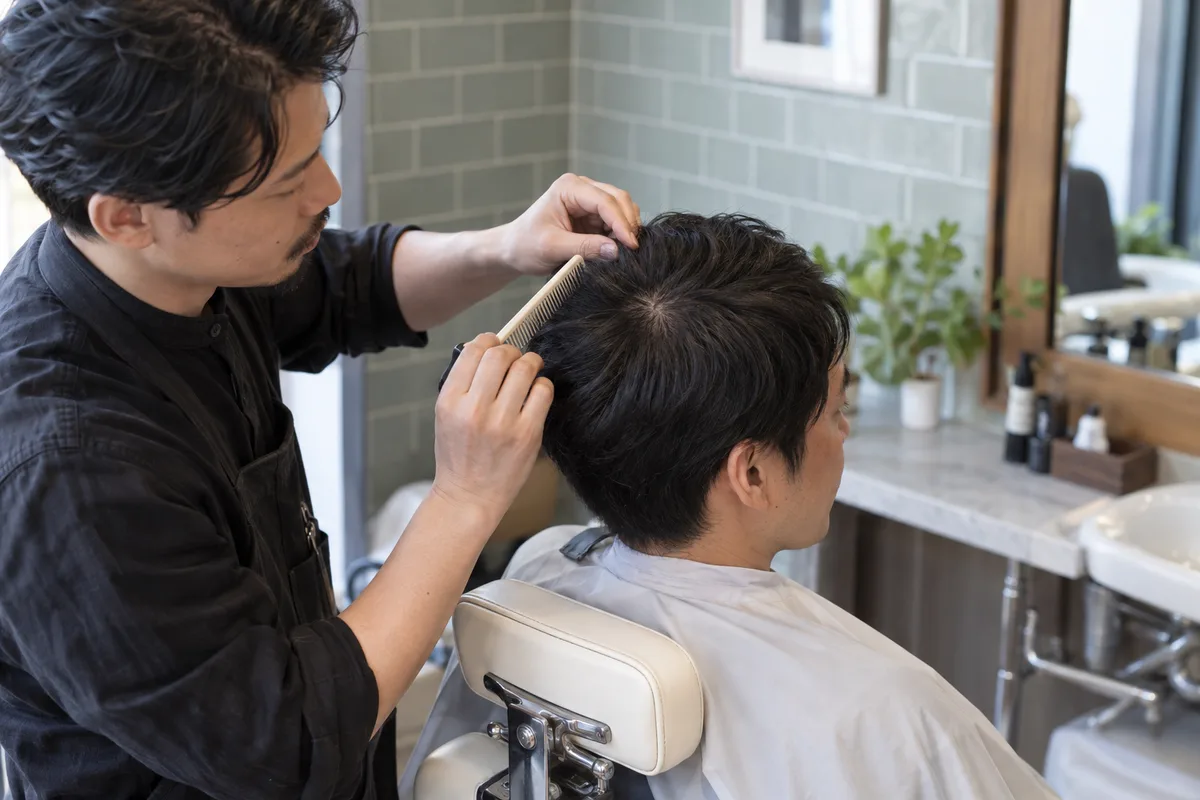
Arrive with the hair in a recognizable everyday state and point out the recurring section before cutting starts. Explain when it rises, what you tried and how much daily effort you accept. Ask the barber to assess direction, density, texture and length together. The conversation is more useful than requesting a random short guard because an online comment said shorter always removes a cowlick.
Discuss two possibilities: leave enough length to work with the section, or choose a shorter texture that accepts its lift. Neither is automatically correct. A particular intermediate length may stand out more on your head, while another cut may need more styling than expected. Ask what the shape will do after washing at home and during grow-out. Do not remove more hair yourself to chase a perfectly flat patch.
A reference image communicates taste, not a contract that your hair will behave like someone else's. Ask for a demonstration you can repeat without special tools or force. If the proposal requires a daily routine you dislike, say so before the cut. Agree on the section to preserve, the overall silhouette and a realistic maintenance plan. You can also leave the style unchanged while learning more about its behavior.

Use MogRise for context, not a cowlick diagnosis
If you use MogRise, begin with clear front and profile photos that show your usual hair framing. Keep the camera roughly at eye height, the light broad and the expression relaxed. A guided face analysis and its explanations can help organize what you want to change. Choose one styling priority rather than treating every part of the report as another task to complete immediately.
A face-analysis app does not replace a physical inspection of crown growth, hair density or scalp health. Do not infer that MogRise measures a cowlick, predicts its exact haircut length or diagnoses loss from a facial score. The relevant outcome is a useful question for your barber: can this front lift become part of a soft shape with less daily effort? FaceScore and PSL remain planning context, not measures of human worth.
MogRise is free to download, with in-app purchases; that does not mean every feature or unlimited use is free. You can make the styling notes without uploading anything. For a bounded reference method, our appearance progress photos guide helps keep comparisons fair. Add a crown reference only if it answers your own styling question, store it privately and avoid repeatedly rescanning for tiny score changes.
Review the routine after an ordinary day
Compare the time spent, comfort, touchable finish and how the hair behaves after your usual commute or hat. A useful test includes ordinary movement, not only a carefully staged portrait. Record a short observation once: the front stayed clear of the eyes, the back rose again, or the extra product felt too stiff. Keep the result separate from lighting and pose changes that merely made the photo look different.
If the improvement is modest but the routine is easy, that may be enough. If the section still returns and the effort keeps growing, stop escalating. Take the note to the next haircut appointment and discuss an accommodating shape. You do not need a permanent-fix promise or a perfectly smooth crown to have a deliberate hairstyle. A clear decision, including the choice to leave some natural movement, closes the experiment.