
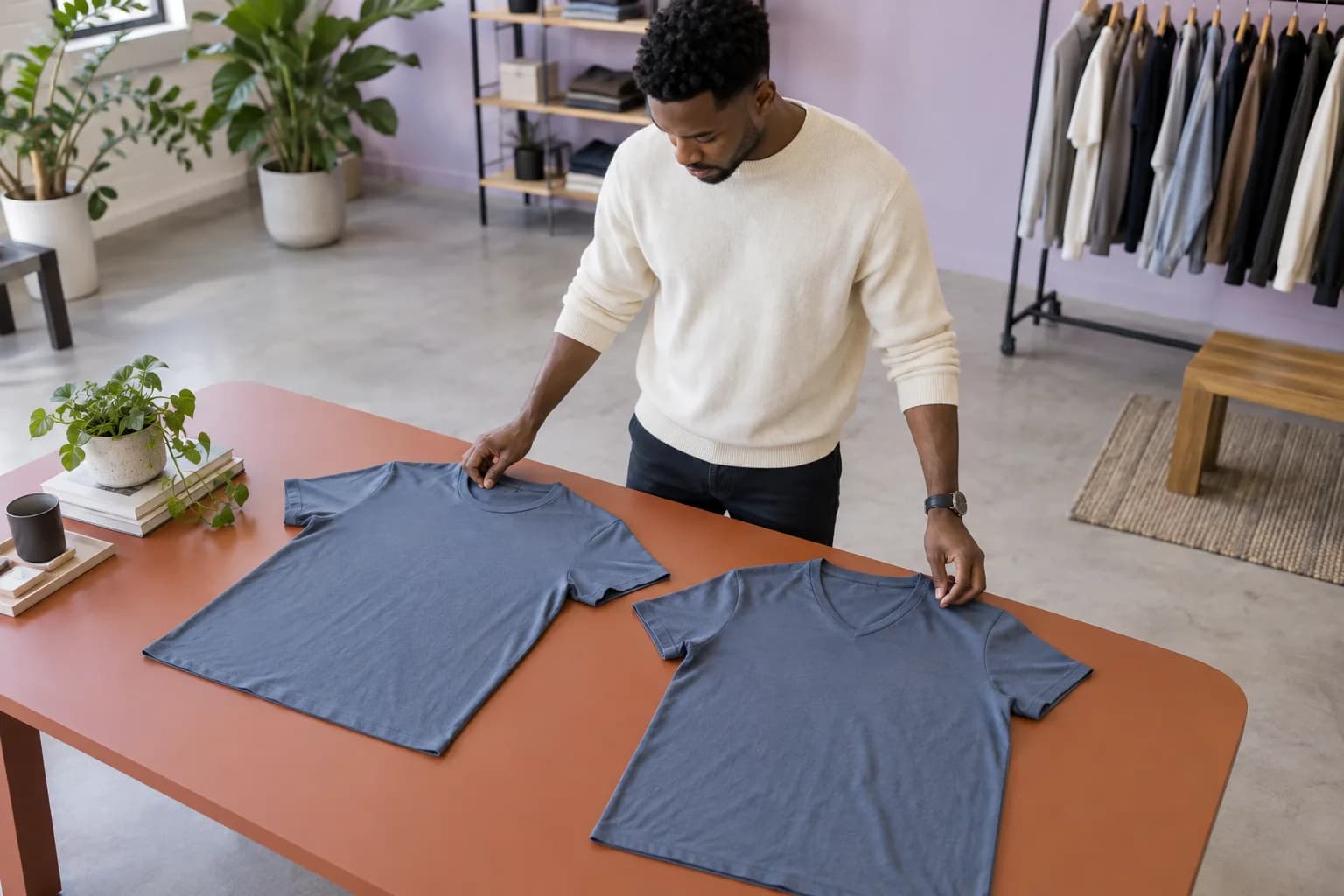
The useful answer to crew neck vs V neck is to choose the shirt that fits your shoulders, feels comfortable at the neck and works with your normal layers. A crew neck gives a continuous rounded opening; a V neck adds an opening toward the chest. Neither automatically suits or improves a particular face shape. Try comparable shirts, check them while moving, and compare full head-and-shoulder photos before buying more. Your own comfort and intended outfit matter more than an online rule about looking broader or slimmer.
This is a small, reversible style decision, not a correction to your face. MogRise can help organize observations from clear front and profile photos into a manageable appearance priority, but it is not a virtual fitting room or a neckline-ranking tool. The guide below gives you a complete fitting process first, then explains where an app-assisted review may be useful. You can reach a good decision without a score or a new purchase.
Crew neck vs V neck starts with the actual opening
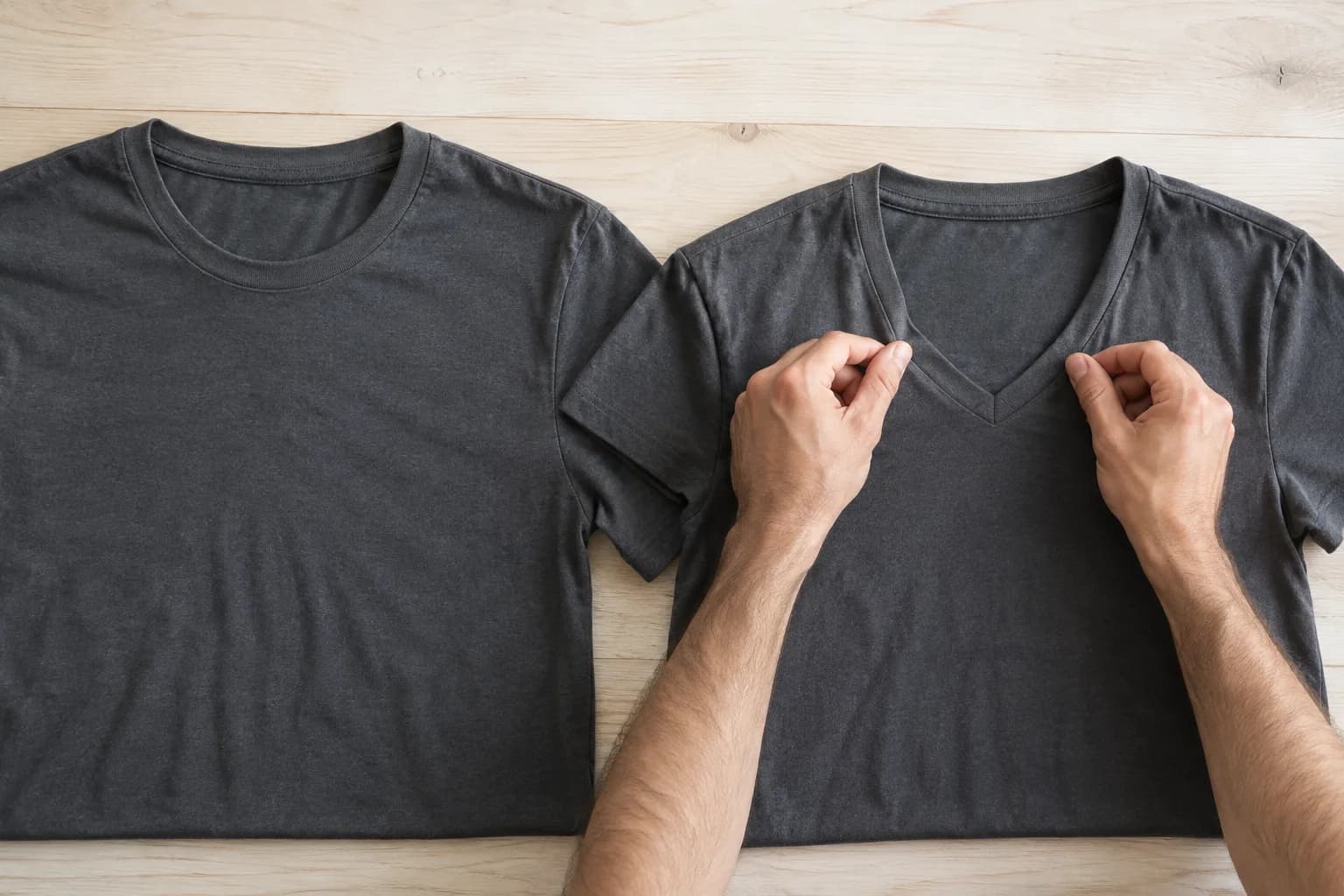
Put the two garments beside each other before trying them on. Look at the width of the opening, how low it finishes and how firmly its edge is constructed. A crew neck can be close and high or noticeably wide; a V can be shallow and restrained or deep enough to dominate an outfit. Those differences may matter more than the name on the product page. Compare similar fabric weights and body cuts so you are not judging a loose lightweight shirt against a tight heavy one.
The neckline is one part of the garment, not a promise about your appearance. A rounded edge creates a different frame from two diagonals meeting below the throat, but the visible result also depends on your shoulders, hair, jacket and camera crop. Start with a shallow V if you want to test an open shape without a large change in coverage. Start with a regular crew if you want a simple baseline. Neither starting point is a universal recommendation for every man.
Check shoulder fit before blaming the collar
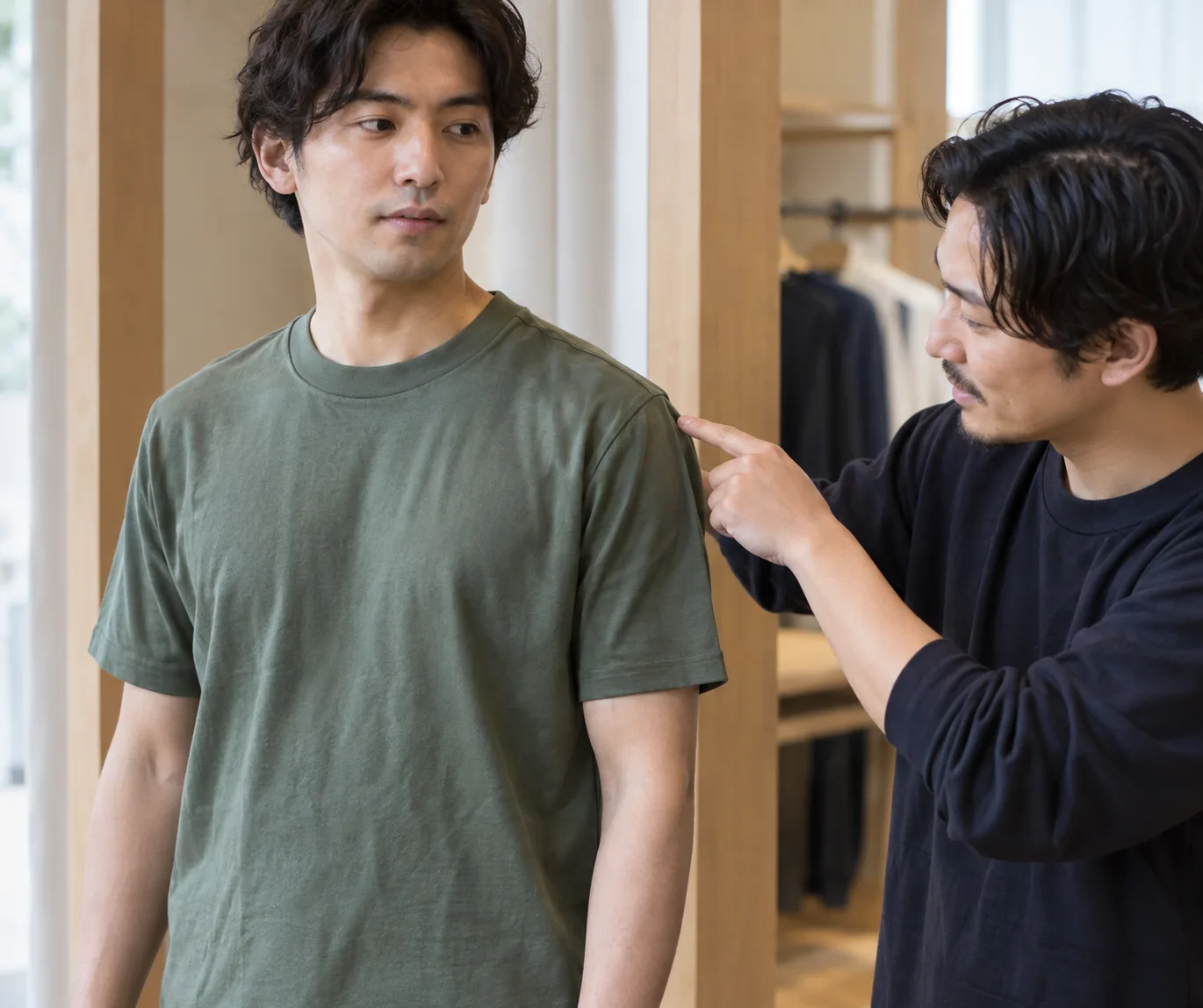
Wear the shirt with your usual trousers and let your arms hang naturally. For a conventional set-in sleeve, inspect where the shoulder seam sits relative to your shoulder; intentionally dropped-shoulder designs are a different cut, not a failed fit. Look for fabric pulling across the upper chest or bunching near the armpits. If the whole top is too small or too large for the look you want, changing a round opening to a V will not solve that problem.
Now raise your arms, sit down and reach forward. Does the hem ride up so much that you keep adjusting it? Does the neckline move away from your body or pull toward the throat? Check how the back hangs as well as the front. A useful fit lets you do ordinary things without repeatedly rearranging the garment. Try another size or body cut before deciding that all crew necks feel restrictive or all V necks look loose. One badly fitting shirt cannot represent a whole category.
Use comfort and coverage as real decision criteria
Notice the sensations you would actually live with: an edge touching the throat, a scratchy seam, a label at the back or too much exposed chest for your preference. You do not need to tolerate discomfort because someone says a shape is flattering. A wider crew may solve the feeling of a close collar; a shallow V may give more open space without being especially deep. Try both while looking down and leaning forward, not only while standing upright in front of a mirror.
Choose coverage for the setting as well as for yourself. A shirt for a relaxed afternoon may not be the shirt you want under a work jacket. If you will keep pulling the opening upward, choose a higher version. If you enjoy an open neckline, that preference is legitimate too. Ignore claims that one shape makes every man more masculine, younger or attractive. Clothes can change the frame and overall impression of an outfit, but they do not establish a person's value.
Face-shape rules are a hypothesis, not a verdict
You may see advice that a round face needs a V or a long face needs a crew. Treat that as an idea to try, not as a rule. A face does not come with one prescribed shirt opening, and the categories themselves hide variation in hair, beard, neck and shoulder proportions. A wide V and a narrow V can produce very different impressions. If you like a crew with a rounded face, there is no need to replace it to satisfy a diagram.
Instead, state the visible question in ordinary language: does this opening leave the amount of space I like between my chin and shirt, and does the whole outfit feel coherent? Look at the entire head and shoulders rather than cropping to the jaw. If another styling issue matters more, such as a shirt that twists or a jacket that restricts movement, handle that first. The purpose of an appearance plan is to reduce unnecessary decisions, not to turn every facial feature into a wardrobe constraint.
Make a two-shirt photo comparison you can use
Choose two tops in a similar color and fabric, ideally with the same body fit. Keep your hair, facial hair and outer layer unchanged. Place the camera at roughly eye level far enough away to include your head, shoulders and upper torso; leave it in the same position for both shirts. Use soft daylight and avoid a beauty filter. Take one relaxed front view and one side view for each option. The aim is to compare clothing, not to manufacture a dramatic before-and-after result.
Look first at the garment: does the edge sit flat, does the opening drift, and do the shoulder seams look as intended? Then look at the overall frame. A bright shirt against a dark shirt may change contrast more than neckline shape does, so do not attribute every difference to the collar. If your two available shirts differ a lot, label the comparison as two outfits rather than a clean neckline test. Keep the useful observation and avoid turning a small preference into a precise claim.

Let MogRise support the priority, not choose the winner
If you already use MogRise, begin with clear front and profile photographs and read the explained analysis as context. It may help you decide whether your current focus should be a simple styling experiment rather than a complicated overhaul. Write down one question before reviewing anything: for example, whether a slightly more open collar feels consistent with the hair and clothes you usually wear. The actual fit, fabric feel and coverage still require a real try-on; an image analysis cannot assess those sensations.
Do not submit endless pairs until a score favors your preferred shirt. A FaceScore or PSL-style output is not a validated verdict on necklines, and different framing can change what a system reads. Use an observation to set a modest experiment, then judge the garment with your own eyes and daily experience. MogRise is free to download, but that does not mean every feature or unlimited use is free. The app is optional: a consistent pair of photos and a short note can be enough.
Check the neckline with the layers you really wear
Put on your usual overshirt, cardigan or jacket and look at the complete combination. A crew may create a visible band inside an open shirt; a shallow V may leave a different amount of space. Neither is inherently neater. Check whether two openings sit deliberately together or whether an undershirt edge appears where you do not want it. A V-neck undershirt hidden under a buttoned shirt solves a different problem from a V-neck tee worn as the main top.
Include the real setting in the test. Sit at a desk, put on a backpack or walk outside with the layers fastened as you normally wear them. Check warmth and comfort yourself rather than assuming that the shape alone controls them; fabric, sleeve length and the other garments also matter. If a work setting has a dress code, follow it. You may end up keeping both shapes for different outfits, which is a more useful result than forcing one winner for the entire wardrobe.

Inspect construction and follow the care label
Before buying, inspect the ribbed edge, stitching and the point of the V. Look for puckering, a twisted edge or an opening that already sits unevenly. These are observations about that item, not proof that one neckline is more durable. Try the shirt again after its normal wash if you own it, and note whether the shape still works. A worn-out collar and a new collar are not a fair comparison of round versus V designs.
Follow the garment's washing and drying instructions rather than applying one temperature to every cotton-looking shirt. The U.S. Federal Trade Commission's care-label guidance explains why regular-care instructions and relevant warnings belong on clothing sold in its market. It is not a rule that one neckline lasts longer, nor a statement about every country's labels. The practical lesson is simple: read the actual care information, avoid pulling the shirt off by its collar, and choose maintenance you can realistically follow.
Finish with a small wardrobe decision
After the try-on, keep one sentence about fit and one about use. For example: the regular crew sits comfortably for everyday wear, while the shallow V works under my open overshirt. Wear the preferred option through an ordinary day before buying multiples. Notice whether you forget about the collar or keep fixing it. That real-world detail is often more useful than deciding which still image looks fractionally better. If both work, keep both; if neither works, try a different cut rather than a different face.
Coordinate the choice with what you already maintain. A new haircut or beard shape is not required to make a tee work. If you are also experimenting with hair placement, finish one test before starting the other so you can tell what changed. Set a stopping point: two comparable shirts, one ordinary day and a short note. The best outcome is a reliable outfit you enjoy wearing, not a growing checklist of flaws or an obligation to keep optimizing.