

Philtrum length describes the central distance from the base of the nose to the upper border of the colored upper lip. It is not the height of the whole upper lip, the depth of the groove or a beauty score. A neutral photograph can help you locate the region, but it cannot supply a trustworthy millimeter measurement or establish whether your face needs changing.
Why does the space above my mouth look longer in this selfie? Before accepting a label, check the endpoints, mouth position and photo conditions. This independent guide offers an observation method without an app, a ruler against your face or an appearance ranking. The aim is to understand a feature and leave it in proportion.
Philtrum length starts with two landmarks
Look for the central junction where the underside of the nose meets the skin above the lip. Then find the middle of the upper lip's colored border, not the line where your two lips meet. Those are different lower endpoints. The NIH anatomy description identifies this nose-to-border region and distinguishes the groove from its bordering ridges. It provides anatomical vocabulary, not a target for attractiveness or permission to diagnose yourself from a picture.
Keep the photograph large enough to identify the boundary, but retain the rest of the face. If a highlight hides the lip border or a shadow obscures the nasal base, record that you cannot see the endpoint clearly. Do not substitute the bottom of a nostril, the nose tip or a mustache edge because it makes a convenient line. An uncertain starting point remains uncertain even when software draws it neatly.
A useful first note is descriptive: the nasal base is visible, the lip border is partly obscured, and the mouth is relaxed. That is more informative than a number produced from guessed points. If you are comparing an explanation online, ask whether it uses the same boundaries. Two diagrams can both say upper lip while describing different spans. A common label does not guarantee a common measurement.

Length, groove depth and lip fullness are separate
The vertical span above the colored lip is one observation. How clearly the central groove appears is another. The amount of colored upper lip visible below the border is a third. A photograph with strong side lighting can emphasize the groove without changing its length. A relaxed upper lip may show a different outline from a deliberately rolled or pressed lip. Describe each variable separately before deciding what caught your attention.
For example, you might initially call the whole region long when your actual concern is that the upper lip looks less visible in a particular expression. Or you might notice a flat-looking patch because the light removes the groove's shadows. Neither observation establishes that the nose-to-border span is unusual. The practical next step is to check expression or lighting, not to infer a structural problem from the first impression.
The broader facial-thirds guide explains the larger vertical zones of the face. This smaller nose-to-lip question belongs within that context, but it is not the same task. Do not add an upper-lip span to a facial-third height as though they were independent scores. Overlapping measurements can describe the same area repeatedly, giving one small feature far more attention than it deserves.
Make a reference, not a measuring instrument
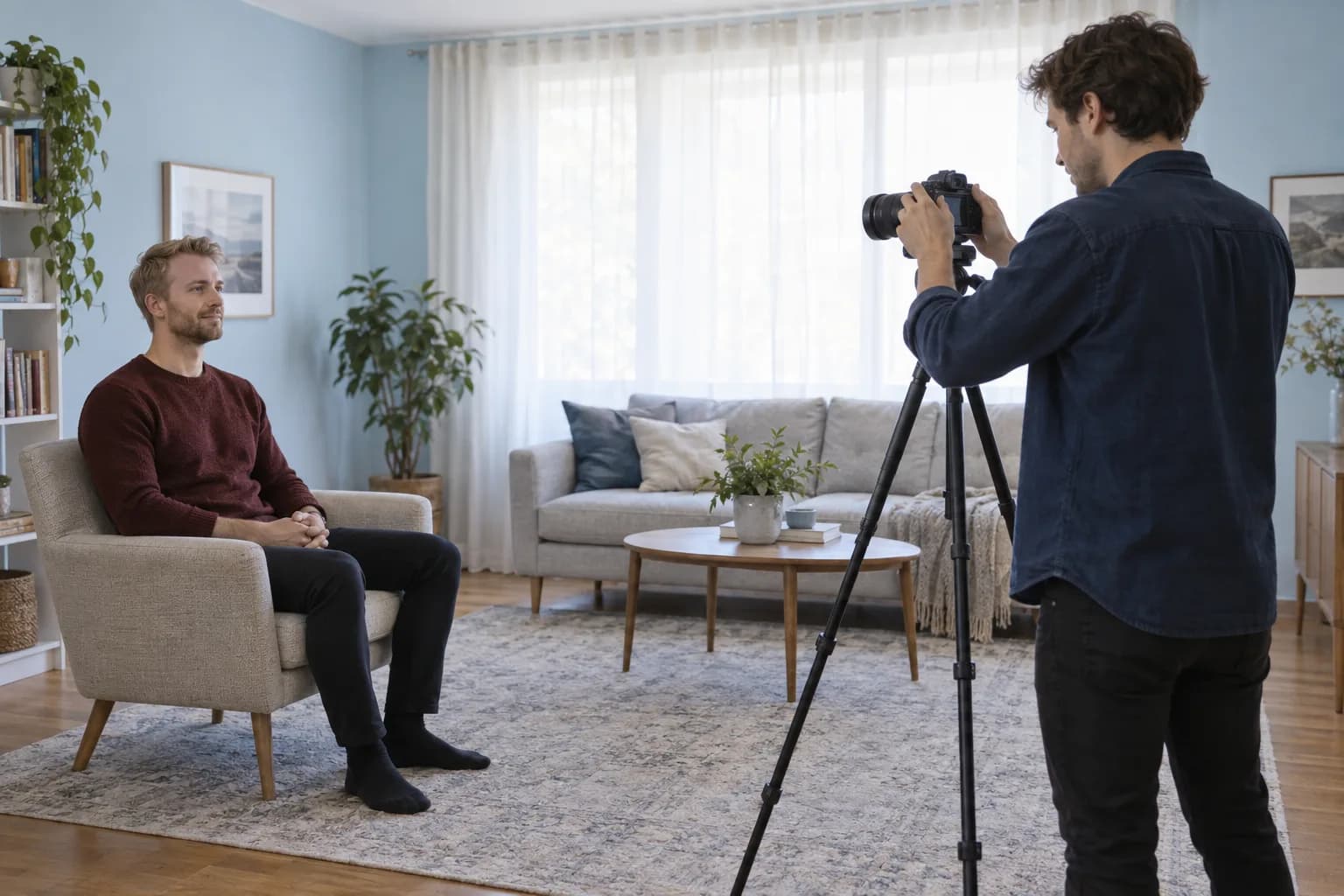
Sit or stand comfortably with the camera near eye height and enough distance to include the whole head and shoulders. Use broad, even ordinary light. Ask a friend to take the picture or use a stable support rather than holding a wide-angle camera very close to the mouth. Keep beauty filters and shape corrections off. Take one usable front reference instead of collecting many extreme angles to find the most flattering gap.
Choose a comfortable portrait distance because the purpose is to see the whole region in context, not to produce an extreme close-up. Keep that distance similar if you compare references later. Do not treat this practical setup as validation of a philtrum calculator or a known error margin for your face. Distance and framing are capture choices, not treatments. Moving a camera changes the picture, not the anatomical length of the region being photographed.
Pixels are not millimeters. Resizing the image, using a different crop or enlarging it on another screen changes its displayed size. Placing a ruler beside the screen cannot recover physical scale. Even a clear-looking portrait lacks the controlled method needed for a clinical measurement. For this guide, your reference is a way to identify boundaries and conditions. Leave the numerical field blank when it is not meaningful.
Let the mouth rest before comparing
Pause speaking and let your usual expression settle. Do not force a lip seal, stretch a smile, tuck the upper lip inward or pull it down to create a preferred outline. If your natural resting position is difficult to hold for a photograph, note the limitation instead of practicing a strained pose. Comfort takes priority over making the endpoints look convenient. The task is ordinary observation, not a test of how long you can keep still.
A smiling picture and a resting picture answer different questions. Both can be honest portraits, but they should not be used as if the same boundary stayed fixed. Keep a smile for the social photograph you like. Use the resting reference only for the narrow descriptive question. There is no requirement to look expressionless in everyday life, and a more attractive smile is not evidence that an anatomical gap has improved.
If an apparent difference disappears when you compare two similarly relaxed images, the useful conclusion is that the original comparison was unsuitable. You do not need to decide which expression reveals the real face. Your face includes movement. Avoid training yourself to maintain one artificial lip position throughout the day or interpreting ordinary speech as a defect to conceal.

Why long or short does not choose an ideal
A long-looking span is a comparison, so ask: compared with what? Your own matched photograph, a diagram with named landmarks, or a selected face in a social feed? Those comparisons have different purposes. A label without a method or a relevant reference tells you little. Avoid turning an isolated numerical range from a cosmetic page into a pass-or-fail threshold for every adult face.
A ratio also needs two defined spans. If the denominator is a lip-to-chin distance, changing that distance changes the ratio even when the nose-to-lip span stays the same. The number does not reveal which component produced it. Choosing another lower endpoint creates another ratio. You can explain this arithmetic without treating any popular proportion as universally beautiful, healthy or appropriate for your face.
A FaceScore or PSL number cannot settle the question by itself. It compresses a model's interpretation of an image, not the worth of the person in it. If a report uses a philtrum label, look for explained observations and uncertainty rather than assuming a dedicated clinical measurement. MogRise is free to download, but not every feature or unlimited use is necessarily free; no purchase is needed to follow this guide.
Read the whole face at ordinary distance
After identifying the region, return to the complete portrait at a normal viewing size. Notice the relationship among the nose, visible lips, chin and expression without ranking them. An enlarged mouth crop removes context and encourages tiny boundary differences to become the whole story. If the feature was not bothering you until you saw an extreme crop, that is worth recording alongside the observation.
Use the same restraint for neighboring features. The eye-spacing guide addresses a different pair of landmarks, not another score to add to the philtrum. You can learn the vocabulary of several regions without accumulating a checklist of supposed flaws. For a practical appearance decision, pick something genuinely controllable, such as a clearer photograph or a comfortable existing grooming routine, rather than treating every anatomical term as an improvement assignment.
Ask a trusted person a narrow, non-rating question if you need help: can you see where the colored lip begins in this reference? Do not ask them to vote on whether your philtrum is acceptable. Their ability to identify a boundary is useful; their personal taste is not a clinical standard. Keep the conversation about the picture and your goal, not a comparison with another person's anatomy.

Use one bounded observation session
Set a simple stopping point before opening the photograph. Identify the two endpoints if visible, write down expression and capture conditions, and decide whether the comparison is usable. That completes the session. You do not need a daily log of the gap, a second opinion from many scoring tools or a collection of decimal values. Repeated inspection can make an ordinary feature feel increasingly important without improving the evidence.
If you want to improve the reference, change only the capture problem you identified. Replace uneven lighting or a very close angle, then keep the usable image privately. Do not change grooming, expression and camera distance together and claim the resulting picture proves an anatomical improvement. A tidy record of conditions is enough. There is no need to upload another person's face or store identifiable photos in an unfamiliar service.
If inspecting your face becomes distressing or hard to stop, close the images and step away from the exercise. You can seek supportive professional help for that distress without first proving that a measurement is abnormal. New pain, injury or concerning physical changes belong with an appropriate health professional, not a photo score. Ordinary feature education cannot diagnose conditions or recommend an irreversible intervention.
A useful conclusion can be no change
You may finish with a modest statement: I know which region the word describes, but this photo does not support a numerical conclusion. Or you may learn that the apparent length differed because the mouth position and framing were not matched. Both outcomes answer the original question more honestly than chasing an ideal range. Understanding anatomy does not create an obligation to alter it.
Keep the reference only if it serves a real purpose, and return to the activities in which your face naturally moves. A familiar smile, comfortable conversation and an ordinary portrait do not need approval from a ratio. The feature can be part of your vocabulary without becoming the center of your appearance plan.