
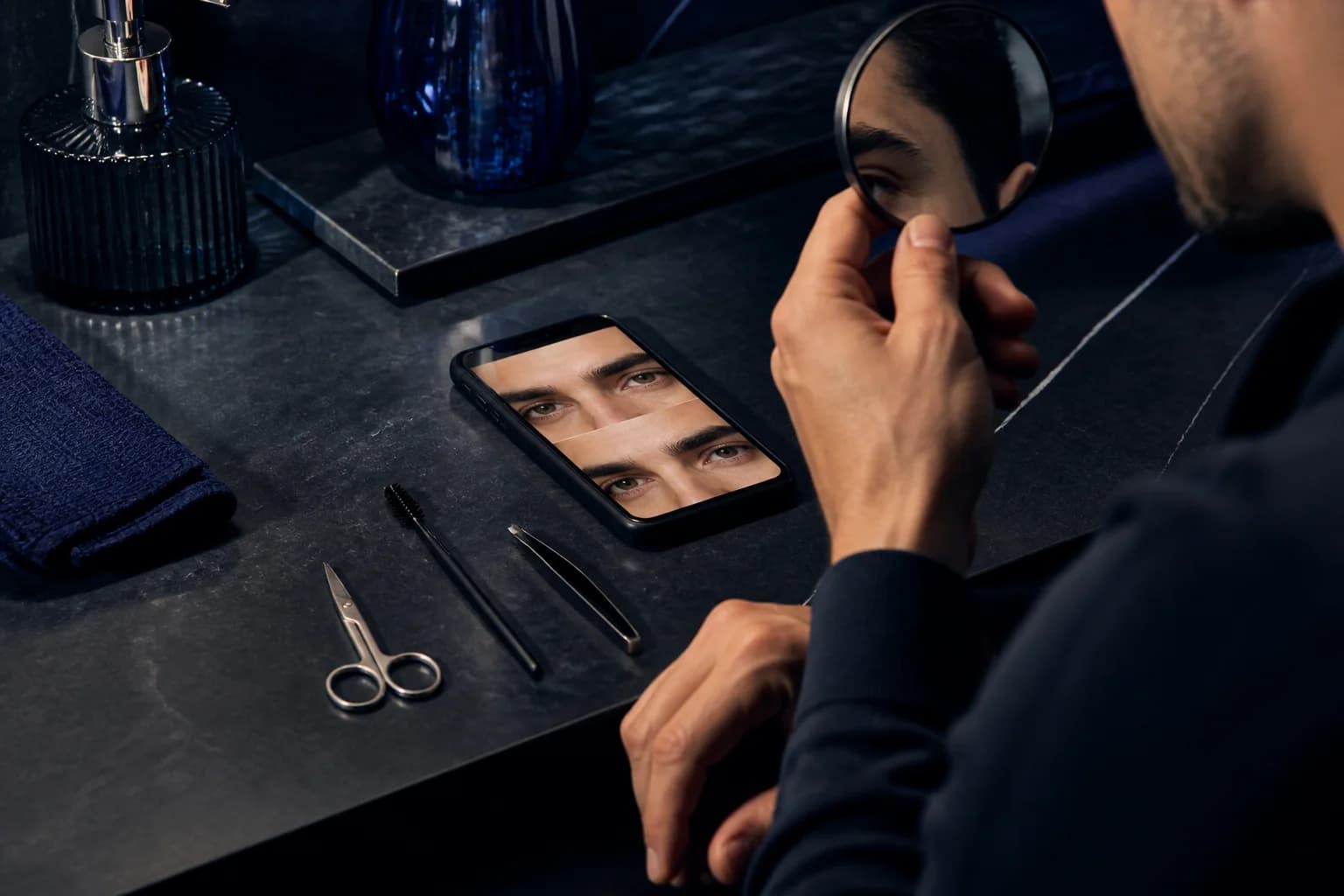
Well-groomed eyebrows make the existing eye frame look clearer. They do not need to become thin, perfectly symmetrical or sharply drawn. On most men, the strongest improvement comes from combing the hairs into one direction, controlling a few long tips and cleaning the obvious outliers while leaving the natural density in place.
The order matters because trimming can solve what first looks like a shape problem. Start by observing the complete face, brush and shorten length, and use tweezers only at the end. This conservative workflow produces a natural result that is easier to repeat and easier to coordinate with the complete MogRise Glow Up plan.
Read your natural eyebrow shape before changing it
Wash your face, let the brow hairs dry and stand in soft light from the front. Look in a normal mirror from conversation distance before using any magnification. Notice where the density begins, how the hairs travel, which tips are visibly long and which isolated hairs sit between the brows or far beneath the main lower edge.
The two brows will not be identical. One may begin slightly higher, carry more density or rise at a different angle. The useful target is a calm shared direction, not a geometric copy. Trying to force exact symmetry often removes the very texture that makes the result look natural and masculine.
Take a neutral front photo before the first cut. Keep the camera at eye level, relax the forehead and eyes, and avoid portrait filters or dramatic side light. This baseline protects your judgment when a close mirror makes every tiny difference seem more important than it is in the complete face.
Use three tools in the right order
You need a clean eyebrow brush or spoolie, small precision scissors and good tweezers only when needed. Work on dry hair in even light. A normal mirror should remain your main reference; magnification is useful for one precise cut, but it is a poor place to decide the overall shape.
Brush the hairs upward and slightly outward. This exposes the tips that truly rise above the natural upper line. Cut those tips one at a time with the scissors held safely away from the skin. Do not run the scissors across the entire brow as one straight line, because varied hair length creates natural volume and prevents hard gaps.
Brush the hairs back into their normal direction and reassess before touching the tweezers. Many brows that look untidy need less length, not less density. Trimming first lets you see whether a hair actually sits outside the shape or simply appeared displaced because it was too long.
- Spoolie to reveal the real growth direction
- Small scissors for individual long tips
- Tweezers for a few clear outliers
- Soft front light and a normal mirror
Trim length without flattening the brow
Begin at the inner third and move outward slowly. Hold the brush loosely beneath the hairs rather than pulling them high under tension. Trim only what remains visibly beyond the main boundary. Some hairs will not need a cut, and that difference in length is what keeps the surface full rather than clipped flat.
Near the arch and tail, the growth direction often becomes more diagonal. Brush that area outward instead of straight up. A tail cut too short can make the eye frame end abruptly, while a center cut into one flat block can remove character. Preserve the existing length unless it clearly falls away from the shared direction.
After a few cuts, step back. Move your forehead and eyes naturally and view the brow from several angles. A small gap can look dramatic at five centimeters and disappear completely at conversation distance. The wider view should always have permission to stop the close work.
Tweeze less and protect the natural frame
Start with isolated hairs clearly between the brows. Follow the naturally dense inner edge instead of creating a wide gap from a generic measurement. Too much separation disconnects the brows from the eye area and takes much longer to grow back than it took to remove.
Under the brow, remove only hairs that sit well away from the main shape. Be especially conservative above it, because the upper contour carries much of the natural character. Tweeze in the direction of growth and return to normal viewing distance after every small zone instead of completing one entire side in a close mirror.
The comparison in this article makes the complete-frame principle visible. Clean brows become more effective when they coordinate with premium hair, precise masculine beard framing, rested eyes, polished natural skin, upright posture, stronger shoulders and fitted dark clothing. A complete transformation reads more clearly than an overworked single detail.
If you cannot identify a distracting hair from normal viewing distance, you probably do not need to remove it.


Coordinate eyebrows with face shape, glasses and beard
Dense, relatively straight brows can reinforce a strong horizontal eye line. A softer natural arch can sit comfortably with longer or oval proportions. Treat these as styling directions, not fixed rules. Real growth pattern, brow density, hairstyle and the impression you want to create matter more than an online template.
Put on your glasses after grooming. The upper frame, brows and eyes should remain readable as one composition. A thick frame already adds structure, so an aggressively carved brow can make the area busy. A precise beard can define the lower face; preserving natural brow weight then keeps the upper and lower frames in balance.
MogRise helps you view these decisions in front and profile context. Keep eyebrow grooming as one small controllable action while hairstyle, beard, skin presentation, posture and clothing remain inside the same personal Glow Up plan. The goal is to strengthen the complete face rather than optimize one centimeter above the eye.
Build a simple maintenance and comparison routine
Brush the brows briefly during your normal grooming routine. Trim again only when individual tips visibly grow beyond the shape. A scheduled check every one or two weeks is easier to control than daily tweezing, which can make the line gradually thinner before you notice the cumulative change.
Take the comparison photo after any temporary redness has settled. Reuse the same camera, distance, soft light and relaxed expression as the baseline. Compare clarity around the eyes, balance between both sides and the fit with hair, beard and glasses. Do not judge success by the number of hairs removed.
Keep the shape when it looks clean at conversation distance and takes only a few minutes to maintain. If one side grows differently, guide both sides toward a shared direction without erasing every difference. The best men's eyebrow grooming routine is precise enough to improve the frame and simple enough to repeat without constant attention.