
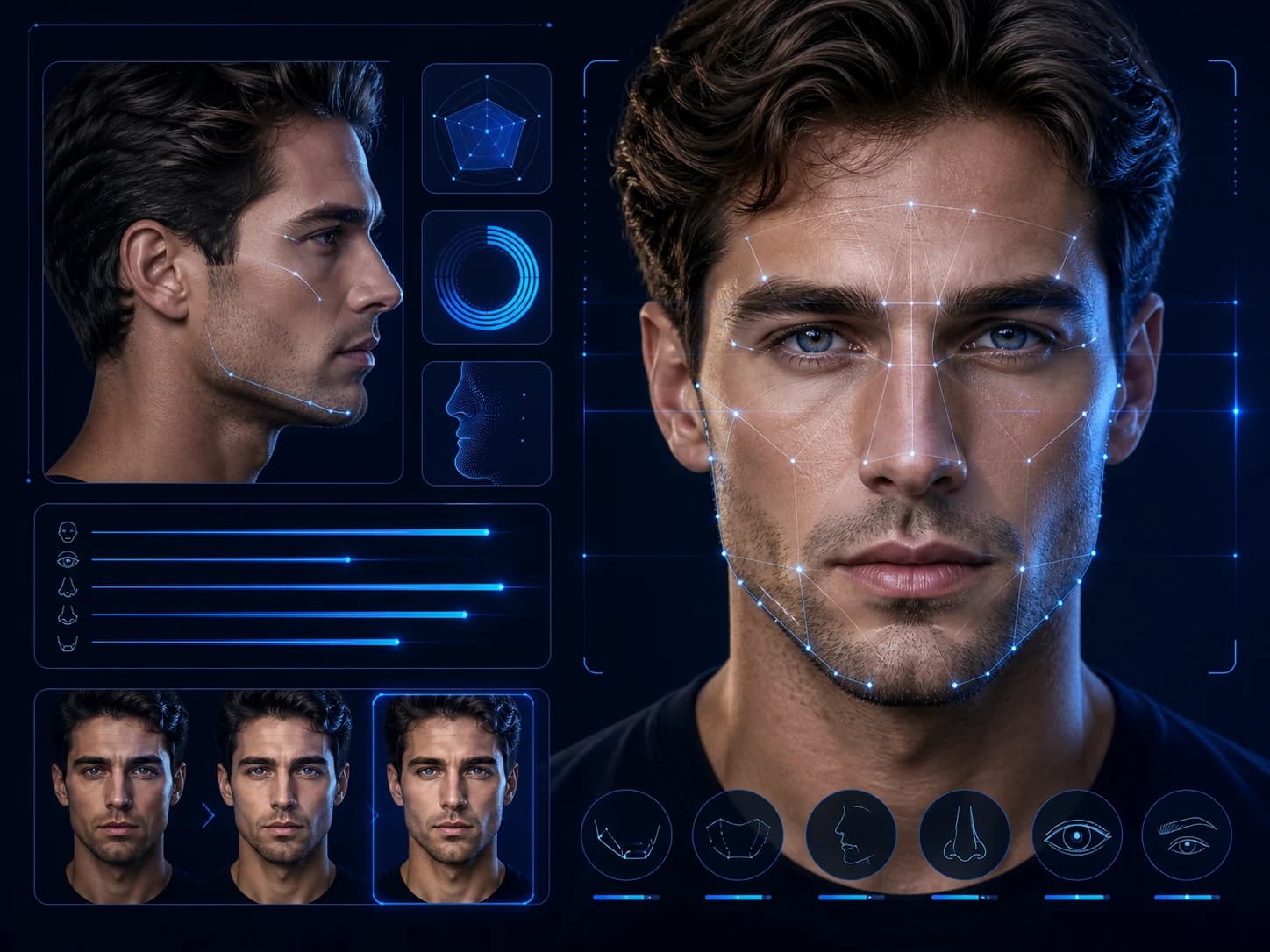
A PSL scale result becomes valuable when it gives you direction. The number is the headline, while the category breakdown shows where your strongest opportunities are and which changes can improve your complete presentation. Instead of collecting isolated ratings, you can use one clear baseline to decide what to work on first.
MogRise turns that baseline into a personal LooksMax AI workflow. You begin with consistent front and profile photos, review the FaceScore categories, compare the visible impact of different priorities and build a Glow Up plan that fits your look. The goal is simple: know where you are, know what to change and know what to check next.
Start with the complete PSL scale picture
Your PSL score gives you a fast overview, but the real detail sits underneath it. Look at how your hairstyle frames the forehead and temples, how beard length defines the lower face, how skin clarity affects contrast, how posture changes the neck and jaw area, and how clothing shapes the overall frame. These categories explain why two men with a similar score can need completely different plans.
Begin by separating your strongest features from your highest-impact opportunities. Strong features give the look its identity and should remain central to your style. Opportunities show where a focused adjustment can create more balance. A good plan does both: it emphasizes what already works and upgrades the details that support it.
Use the PSL scale as a map of your current presentation. When you read the score together with the written analysis, FaceScore categories and images, you get a much more useful picture than a number alone. That complete view becomes the foundation for every decision that follows.
Create a clean baseline for your LooksMax AI analysis
A strong plan starts with clear source photos. Take one front-facing portrait and one side profile at eye level. Use soft daylight, a relaxed expression and a simple background. Keep the camera far enough away to avoid an exaggerated wide-angle look, and make sure your hairline, jawline and full face are visible.
Wear a plain top and remove anything that hides the areas you want to review. A repeatable setup helps you compare changes in hairstyle, beard, skin presentation and posture without the photo itself becoming the main difference. Save the setup you used so your next check has the same angle, light and distance.
MogRise uses these views to organize the analysis around your real presentation. The clearer the baseline, the easier it is to connect each FaceScore category with a practical priority and see how several improvements combine into one stronger look.
- One clear front photo and one side profile
- Soft, even daylight and a simple background
- Eye-level camera with a relaxed expression
- Hairline, face and jaw area fully visible
- The same setup for your next progress check
Read FaceScore categories by impact and control
Read the category notes before choosing an action. Some areas can change the complete impression quickly because they affect the frame around the face: hairstyle, beard contour, eyebrow cleanup, skin presentation, posture and clothing fit. Other details become more effective after that frame is already working.
Rank each opportunity by visual impact, control and effort. A high-impact change that you can maintain easily belongs near the top. For example, a haircut that adds structure around the temples, a beard length that strengthens the lower face or a shirt neckline that improves the shoulder-to-neck transition can influence several parts of the look at once.
This ranking keeps your Glow Up plan focused. You are not trying to change every category simultaneously. You are selecting the smallest set of actions that creates the clearest overall upgrade and gives you an easy result to compare at the next review.
Turn your PSL score into two personal priorities
Choose one primary visual priority and one supporting routine. The visual priority should be easy to notice in photos, such as a new hairstyle direction, beard shape, improved clothing fit or stronger posture. The supporting routine should make that change look consistent, such as regular hair styling, a simple skin routine, scheduled beard maintenance or better sleep timing.
Write each priority as a concrete action. Replace “improve hair” with “ask for a textured cut with controlled volume and style it for five minutes each morning.” Replace “look sharper” with “keep the beard at a defined short length and clean the cheek and neckline twice a week.” Specific actions make your personal plan simple to follow.
MogRise helps connect the category insight to that action. Once the first two priorities are clear, the remaining recommendations become a queue rather than a distraction. You always know what is active now and what can wait for the next stage.
- One visible upgrade with strong overall impact
- One repeatable routine that supports the upgrade
- A clear action instead of a vague goal
- A fixed date for the next comparison


Use before-and-after comparisons to sharpen your eye
A before-and-after view shows how the complete frame changes when grooming, hairstyle, clothing and presence work together. Move the slider slowly and look beyond a single feature. Notice the hair silhouette, temple coverage, beard outline, neck area, shoulder line, color contrast and the way light shapes the face.
The most useful comparison keeps the identity, angle and background consistent. That makes the controllable changes easy to read. You can see whether a sharper haircut adds enough structure, whether stubble or a short beard gives the jaw a stronger visual frame, and whether a darker fitted top improves contrast around the face.
Use that observation to refine your own plan. You do not need to copy another man’s exact haircut or beard. Identify the principle behind the upgrade and adapt it to your own FaceScore categories: more volume, cleaner edges, stronger contrast, better proportions or a more confident frame.
Build a focused 30-day Glow Up sprint
Give your first plan thirty days. Week one is for the baseline and setup: capture the photos, choose the haircut or grooming direction and prepare the products or clothing you need. Week two is about repetition, so the new routine becomes quick and natural instead of something you only do for a photo.
During week three, refine the details. Adjust styling volume, beard length, neckline, eyebrow cleanup, shirt fit or posture cues based on what looks strongest in everyday light. Keep the main direction stable so you can judge the effect of small refinements.
At the end of week four, recreate the original front and profile photos and review the same PSL scale and FaceScore categories. Keep the changes that improve the complete look, then choose the next high-impact priority. This creates a steady upgrade cycle instead of an unfocused list.
- Week 1: baseline, direction and setup
- Week 2: repeat the core routine
- Week 3: refine the visible details
- Week 4: compare, keep and level up
Connect LooksMax keywords to useful actions
LooksMax language is full of specialist terms, but each term is most useful when it leads to a clear action. Depuff AI can point you toward a cleaner morning routine, hydration timing, sleep consistency and photo-ready facial presentation. JawMax topics can become a practical review of beard framing, hairstyle balance, neck posture and body composition.
FaceScore gives you the category structure, while PSL scale gives you a familiar overall reference. Glow Up describes the complete progression, and true potential is the point where the separate upgrades begin to feel like one coherent personal style. MogRise brings these ideas into one plan instead of leaving them as disconnected search terms.
Keep the language that helps you find the right feature, then judge every idea by how well it supports your own face and lifestyle. The strongest personal plan feels specific to you: the haircut works with your hair, the beard fits your growth pattern, the routine fits your week and the style matches how you want to present yourself.
Review your progress and choose the next upgrade
Your next MogRise check should answer three questions: Which change created the biggest visible improvement? Which routine was easiest to maintain? Which FaceScore category now offers the best next opportunity? Those answers turn progress into a simple decision rather than another long list.
Keep a small photo set for each review. A front portrait, side profile and one natural everyday photo are enough to show how the plan reads in different situations. Add a short note about the haircut, beard length, products, clothing and lighting so you can repeat what worked.
Then update the plan. Maintain the successful changes, move one new priority into the active position and give it the same focused time window. This is how a PSL scale result becomes an ongoing LooksMax system: analyze, prioritize, act, compare and level up.